 Shrimad Astro

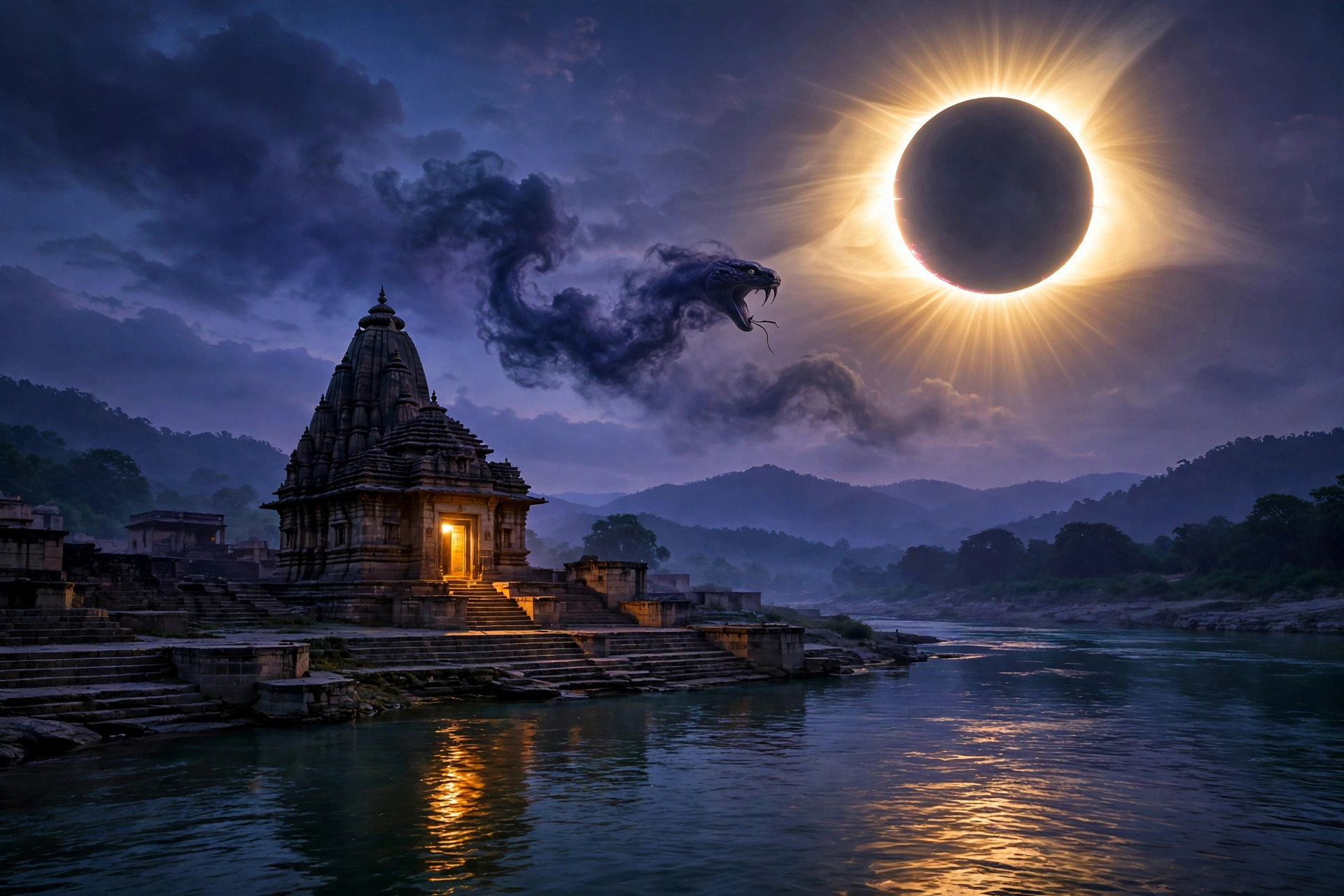
There is a particular moment in a kundli reading that makes shoulders tense up. The astrologer’s finger pauses on the Sun or the Moon, and out comes the word — grahan dosh. The heart sinks. The imagination does the rest.
Take a breath: this is one of the most over-hyped entries in the Vedic vocabulary, and what it actually means is narrower — and calmer — than the fear-selling suggests.
What’s actually in your chart
Grahan dosh happens when the Sun or Moon sits in close conjunction with Rahu or Ketu — same house, huddled together. Not an aspect, not an opposition. Astrologers argue about how close is close enough, and since the sources genuinely disagree on the orb, treat any precise degree claim with suspicion.
Why does it rattle people? Because the planets involved are the two luminaries. The Sun is the father, authority, vitality, self-confidence — the king of the chart. The Moon is the mind, the mother, emotional peace — the queen. When a shadow node sits on either, tradition says the king or queen gets “eclipsed”: confidence dims, clarity wobbles. Some traditions also read a birth during an actual eclipse as the same family of influence.
The story behind the name
Every pandit reaches for the same story: the Samudra Manthan. The asura Svarbhanu disguised himself as a deva and slipped into the line for amrit. The Sun and Moon spotted him; Vishnu severed his head with the Sudarshana Chakra before the nectar passed his throat. The head became Rahu, the body Ketu. And since it was the luminaries who exposed him, Rahu periodically “swallows” one of them — an eclipse is his revenge, and this dosha carries that same image.
The two faces: Surya and Chandra
The tradition splits the dosha in two, and the remedies differ accordingly. Surya Grahan dosh (Sun with Rahu/Ketu) is read around the father, authority, and self-confidence. Chandra Grahan dosh (Moon with Rahu/Ketu) is read around peace of mind, the mother, and emotional steadiness.
In a kendra (1st, 4th, 7th or 10th), astrologers traditionally read it as more visible — that’s tradition, not certainty. And my honest opinion: most panic skips the single most important qualifier — a chart is never one dosha. Judging a life by one conjunction is like judging a meal by one ingredient.
What the classics say — and don’t
Honesty requires this: the named concept “Grahan Dosh” does not appear in Brihat Parashara Hora Shastra or Brihat Jataka. Like Kaal Sarp dosh, it is a later, popular-era formulation built on a classical foundation. The foundation itself is classical — the nodes are malefic shadow grahas in the classical texts, their affliction of the luminaries is noted, and graha-shanti rites exist for exactly such afflictions. So the logic has old roots; only the brand name is new.
Be cautious of Sanskrit verses circulating online to “prove” the dosha’s antiquity — the well-known one has no corroborating source anywhere, and an untraceable shloka is worse than admitting the truth.
Remedies people actually do
The good news: these are gentle remedies — prayer, discipline, charity. Nothing extreme.
For Surya: the Aditya Hridaya Stotra, the Sun hymn sage Agastya taught Rama before his battle with Ravana (it sits in the Ramayana’s Yuddha Kanda). Plus arghya to the rising sun from a copper vessel each morning, and the Sun beej mantra Om Hram Hreem Hraum Sah Suryaya Namah on Sundays.
For Chandra: Shiva is the remedy — Rudrabhishek or Monday Shiva puja is the tradition’s standard prescription (Shiva wears the crescent moon on his head, so the Moon’s affliction is taken to his feet), with the Moon beej mantra Om Shram Shreem Shraum Sah Chandraya Namah on Mondays.
Both types: charity on Mondays or Sundays, or during an actual eclipse — feeding the poor, donating white items (rice, milk) for the Moon or red/gold items for the Sun. Around eclipses, sutak is observed roughly 12 hours before a solar eclipse and 9 hours before a lunar one, and only for eclipses visible from your location — check eclipse and sutak timings rather than panicking blindly. India’s next visible one: the 2 August 2027 solar eclipse, partial from India in the afternoon.
The stotras and mantras live in our Vedic mantra collection and the Sanatan Shastra library, including the Navagraha stotras used in graha shanti.
Quick answers
How do I check if I have it? Look at your Sun and Moon: is either in the same house as Rahu or Ketu? Pull up your chart on our free Janam Kundali and check in seconds.
Does it ever weaken? Tradition says the bite softens when the afflicted planet is otherwise strong — own sign, exaltation, or Jupiter’s aspect — and during strong dasha periods. Transits color everything too; one conjunction never decides a whole chart.
Is Sun worship connected to any festival? The four-day Chhath Puja (13–16 Nov 2026) is the grand festival of direct Sun worship — devotees in the river offering arghya to the rising and setting sun. If Surya remedies appeal to you, that week is when Bihar and eastern UP live them.