 Shrimad Astro

Every few months a friend calls me in a panic. “Yaar, jeweller ne Neelam bola hai, pehnoon ya nahin?” Most people buy the stone before they understand the planet. So let’s fix that: which stone belongs to which planet, how they’re traditionally worn, and the warnings that rarely make it into the sales pitch.
The nine stones, planet by planet
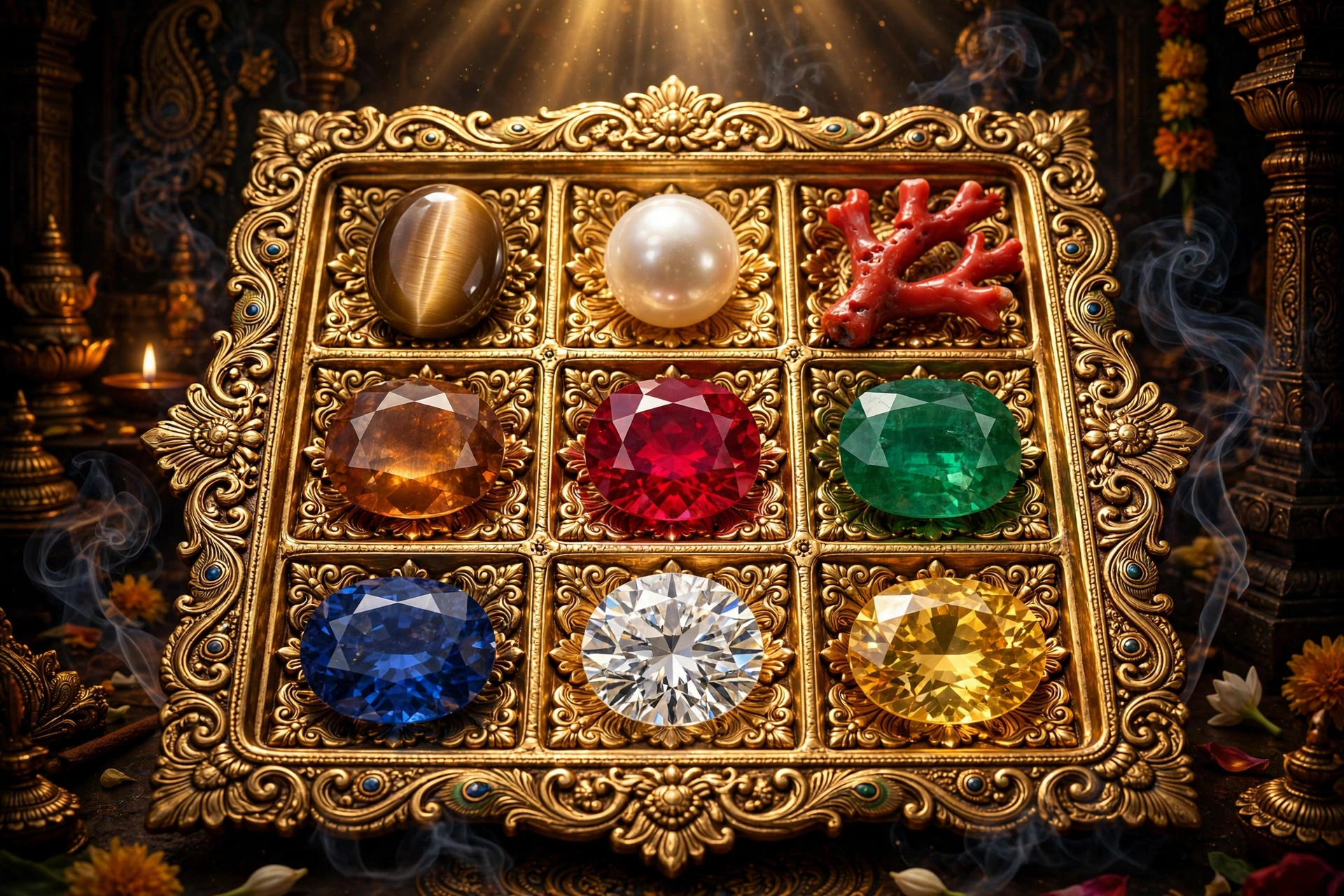
Vedic astrology’s gemstone tradition is called Navratna — nine gems for the nine grahas. The mapping is settled and agreed across every serious source:
- Sun (Surya) — Ruby (Manik)
- Moon (Chandra) — Pearl (Moti)
- Mars (Mangal) — Red Coral (Moonga)
- Mercury (Budha) — Emerald (Panna)
- Jupiter (Guru) — Yellow Sapphire (Pukhraj)
- Venus (Shukra) — Diamond (Heera); White Sapphire as substitute
- Saturn (Shani) — Blue Sapphire (Neelam)
- Rahu — Hessonite (Gomed)
- Ketu — Cat’s Eye (Lehsunia)
In a Navratna arrangement, ruby takes the centre with the other eight circling it — the Sun as the king of the grahas. Before you get excited about any of these, check your chart: our free Janam Kundali shows which planets are weak or troubling for you — that decides whether a stone helps or works against you. The birthstone finder gives a quick first hint by birth month and sign.
How they’re worn: finger, metal, day
The tradition is oddly specific here, and jewellers who follow it insist on these details:
- Ruby — gold, ring finger of the right hand, Sunday morning
- Pearl — silver, little finger, Monday
- Red Coral — gold or copper, ring finger, Tuesday
- Emerald — gold, little finger, Wednesday
- Yellow Sapphire — gold, index finger, Thursday
- Diamond — silver, platinum or white gold, middle or ring finger, Friday
- Blue Sapphire — silver or steel, middle finger, Saturday
- Hessonite — silver, middle finger, Saturday
- Cat’s Eye — gold or silver, little finger, Tuesday
First wearing is traditionally done on a weekday morning during the waxing moon (Shukla Paksha), after the stone is dipped in raw milk or Ganga jal and the planet’s mantra chanted 108 times. Weight matters too: the old rule of thumb is roughly one ratti per 10 kg of body weight, though your astrologer prescribes the exact weight. A stone too small is considered decoration, not a remedy.
The warnings nobody tells you at the shop
Blue Sapphire acts fastest — and that’s exactly why it scares people. Neelam is famous for showing results (good or bad) within days, sometimes hours. Most experienced astrologers and jewellers advise a trial period: wear it for a few days and watch your sleep, temper, and luck before committing. If things go sideways, take it off. It’s the one stone where the tradition itself says “test first.”
Not every stone suits every chart. Wearing the stone of a planet that rules your bad houses (the 6th, 8th, or 12th) can amplify the wrong things. Pukhraj is widely called the safest stone, but even it needs a chart check — it’s strongest for Sagittarius and Pisces ascendants and questionable for others. Moonga for Mars is usually only suggested after confirming Mangal Dosh properly. And here’s my honest opinion: no stone, however expensive, replaces the dasha running in your life. A stone can strengthen a weak benefic planet; it can’t rewrite a bad period.
Never mix enemies. You’re traditionally advised against wearing stones of mutually hostile planets together — the classic example being Neelam (Saturn) with Manik (Sun) or Pukhraj (Jupiter), since Saturn is inimical to both. A jeweller selling you a Neelam-Pukhraj combo is selling you two stones, not one solution.
The fakes market is enormous. Heated, dyed, synthetic, glass — the cheaper the “certified” stone, the more suspicious you should be. Insist on a lab certificate (GIA, IGI, or a reputable Indian lab like GTL or GII) and buy from a seller with a return policy. A treated stone is, by tradition’s own logic, a dead stone.
If a stone isn’t for you, you still have options
Remedies were never only about expensive stones. For every planet there’s a mantra, a deity, and a donation — chanting the planet’s beej mantra 108 times daily costs nothing, and neither does donating yellow clothes on Thursdays for Jupiter. The Sanatan Shastra library has the full Navagraha mantras and stotras if you want the authentic texts. And if you’d rather wear something simpler, a rudraksha bead chosen for your need is the gentler, cheaper cousin of the gemstone.
My take, after years of watching people do this: get the chart read first, by someone who has nothing to sell you. The right stone at the right time is a lovely thing. The wrong stone, bought in a hurry, is just an expensive lesson.
FAQs
Can I wear two gemstones together?
Only if an astrologer confirms the planets are friendly and both suit your chart. Random combinations — especially Neelam with Manik or Pukhraj — are traditionally discouraged.
What if I can’t afford the real stone?
Tradition allows substitutes (White Sapphire for Diamond), but a cheaper authentic substitute beats an expensive fake. Donations, mantras, and rudraksha are the honest fallback — never glass sold as emerald.
How long before a stone shows results?
Neelam is said to act within days; the others traditionally take a few weeks to a full mandala (about 40 days). If nothing shifts after a sincere trial, the stone probably wasn’t the right prescription.