 Shrimad Astro

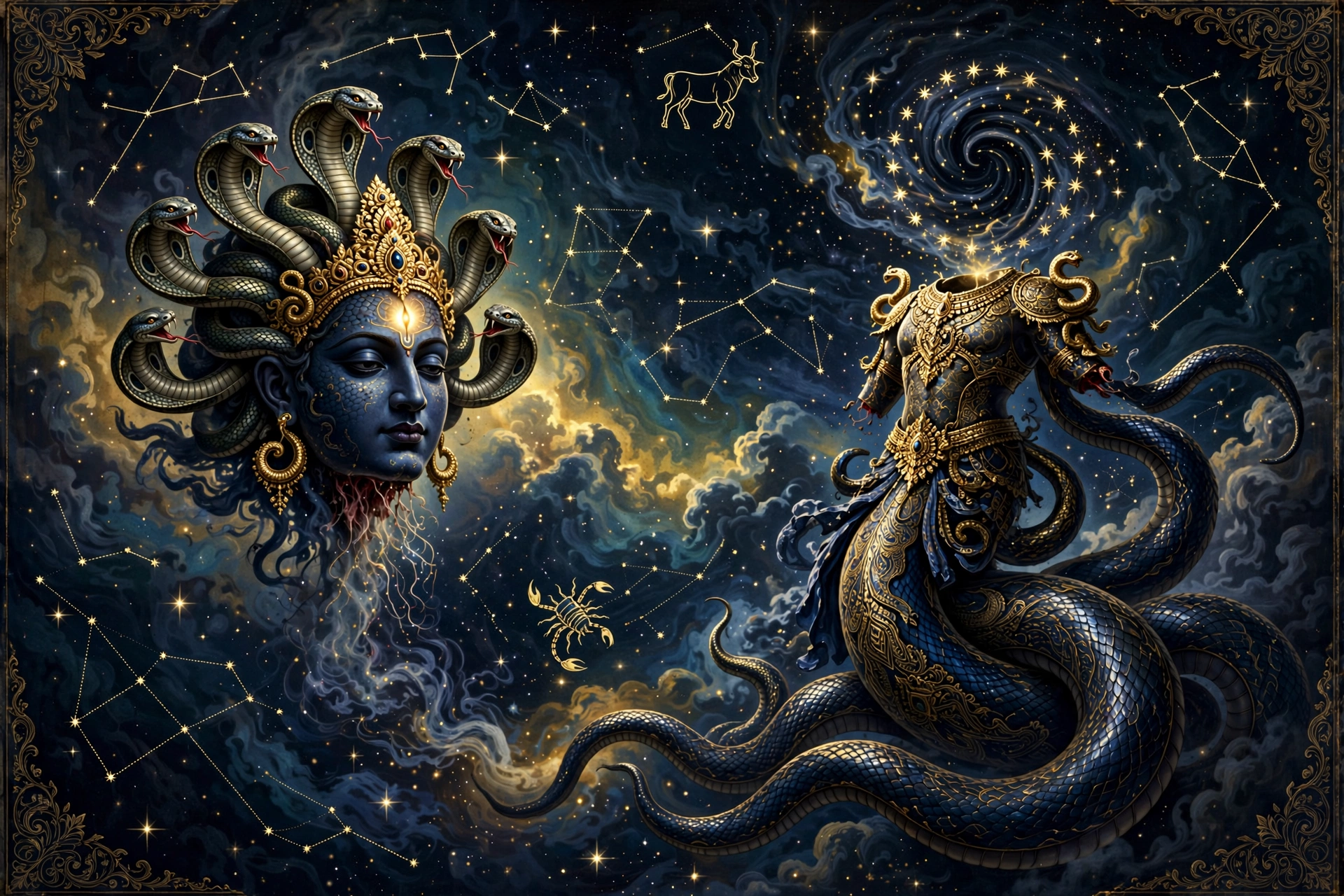
If you’ve had one eye on the sky this year, you know 2026 has been busy for the planets. Venus went retrograde in October, Mercury followed, and now the two shadow planets — Rahu and Ketu — change signs on 5 December 2026, redrawing the karmic axis for the next eighteen months.
Honestly: nodal shifts are slow and structural — they change the background music of your life, not the lyrics.
Wait, who exactly are Rahu and Ketu?
Unlike Mars or Jupiter, Rahu and Ketu aren’t physical planets at all. They’re the two points where the Moon’s orbit crosses the Sun’s path — the lunar nodes. Eclipses only happen near them, which is why the old stories say these two swallow the Sun and Moon. The story goes back to the Samudra Manthan, where the demon Svarbhanu sneaked a sip of the amrit; Vishnu, as Mohini, severed his head — the immortal head became Rahu, the immortal body Ketu.
In a chart, Rahu is the hunger: ambition, appetite, the urge for more — more status, more money, more everything. Ketu is the opposite pull: detachment, letting go. They’re always opposite each other — whatever Rahu stirs on one side, Ketu loosens on the other.
What changes on 5 December
Right now Rahu sits in Aquarius and Ketu in Leo — an axis they’ve held since May 2025. On 5 December 2026, Rahu backs into Capricorn (Makara) and Ketu into Cancer (Karka).
A quick honesty note: some panchangs quote late November instead of 5 December, and neither is wrong. The 5 December date follows the mean-node convention most traditional panchangs use; calculations tracking the true, wobbling node land a few days earlier. Either way the axis holds for roughly eighteen months, through the first half of 2028 — and with a nodal cycle of about 18.6 years, astrologers treat these shifts as generational events. The Graha Gochar guide tracks every major transit in one place.
The big theme: ambition versus belonging
Capricorn is Saturn’s sign — structure, careers, the long game. Rahu here magnifies worldly hunger: promotions, property, public position. Cancer is the Moon’s sign — home, roots, emotional safety. Ketu here loosens attachments: family expectations you’ve outgrown, the comfort of the familiar.
Together the axis asks one question for eighteen months: what are you building, and who are you building it for? Career moves will speed up while emotional dependencies quietly dissolve — job changes, renegotiated family roles, letting go of houses, hometowns, or relationships you’ve outgrown.
My honest take: this is one of the healthier nodal transits. The ambition it stirs is the disciplined, Saturn-flavoured kind. The risk isn’t madness; it’s workaholism dressed up as destiny. If you find yourself skipping every family dinner for “just one more project,” that’s Ketu trying to tell you something.
What to actually do (and what not to)
First, find your Moon sign (Janma Rashi) — Vedic transits are read from the Moon, not the newspaper Sun sign.
Kaal Sarp dosh is a birth-chart condition — all seven planets hemmed between Rahu and Ketu in your natal kundli — not something a transit can give you. The free Kaal Sarp dosha checker will tell you in a minute whether you have it.
Traditional remedies for the nodes are simple, not scary. Read the Navagraha stotras in our Sanatan Shastra library — Rahu is traditionally pacified through Goddess Durga, Ketu through Ganesha. And keep your routine steady during eclipse seasons, when nodal energy peaks: the first eclipse season of the new axis arrives in February 2027, with a solar eclipse on 6 February and a lunar eclipse on 20 February. Tradition says no big announcements and no rushed decisions around those dates. And if you must schedule something important on any day, a quick glance at the daily Rahu Kaal timing is a small courtesy to the shadow planets that costs you just ninety minutes.
Three quick questions
Does the exact date of the shift matter? Not much. Nodal transits are gradual — think of 5 December as the headline date for an eighteen-month arc, not a switch being flipped. The effects build through late 2026 and peak around the eclipse seasons of 2027.
I’m a Taurus by Sun sign — does this apply to me? Vedic astrology reads transits from your Moon sign (Janma Rashi) and your ascendant, not the Sun sign. Two people born on the same day can experience this transit in completely different houses.
Should I be scared of this transit? Honestly, no. Rahu and Ketu sound dramatic, but their transits are mostly slow rebalancing. The people who struggle are the ones fighting the theme: clinging to comfort while ambition knocks, or chasing status while home falls apart.