 Shrimad Astro

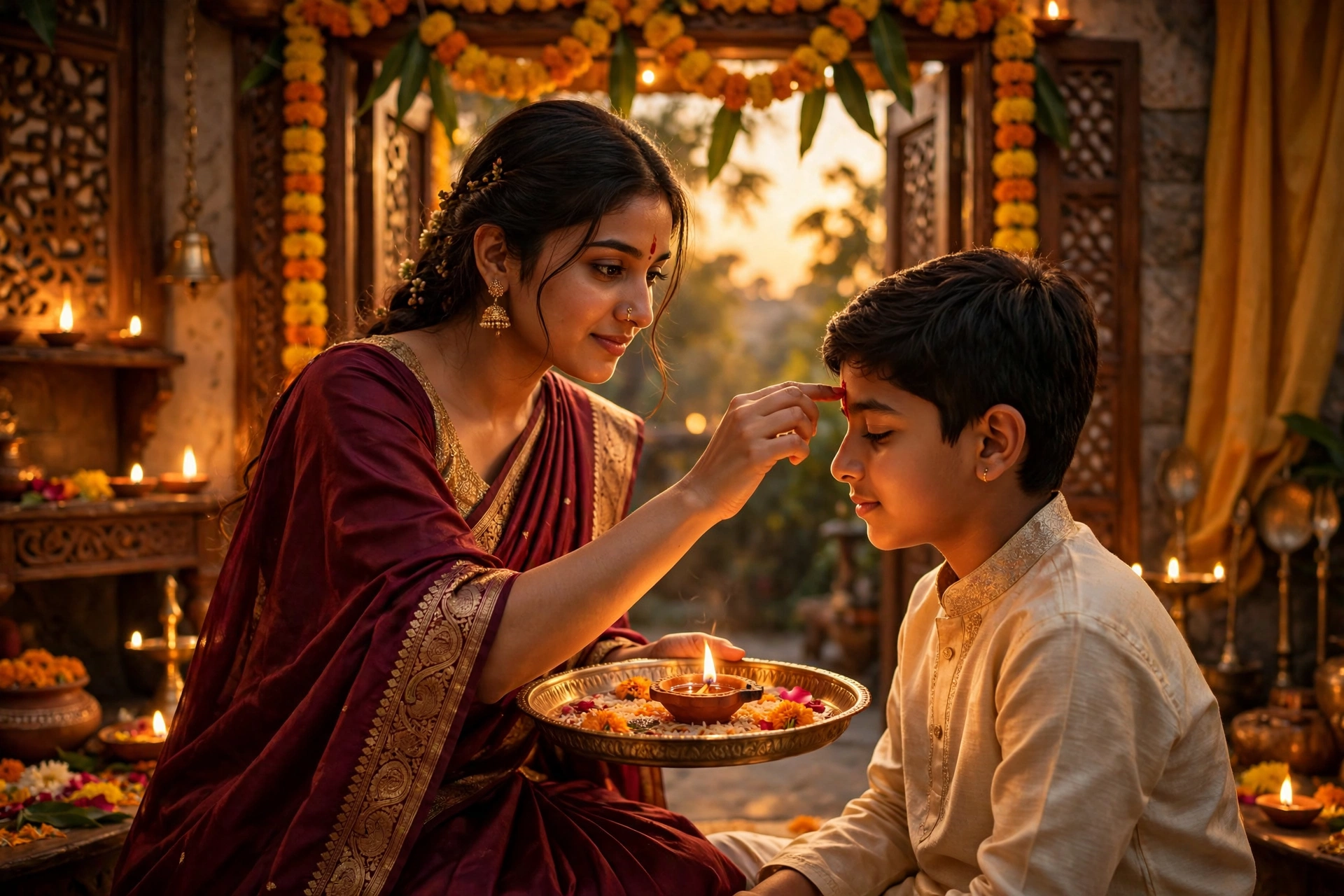
There is one story in Hindu mythology where the god of death loses the argument. Not to another god, not to a rishi, not to some asura armed with a thousand boons. To a sister who simply refused to let him leave her house without sitting down for dinner. That story is Bhai Dooj — the festival that says, with a straight face, that a sister’s blessing can stand up to Yama himself.
Bhai Dooj 2026 falls on Wednesday, 11 November in India, the fifth and final day of the Diwali festival. The tilak is applied in the afternoon, during the Aparahna period. If you’re in the US, UK or Canada, you’ll observe it a day earlier, on Tuesday 10 November — more on that in the FAQs.
Yama came for dinner: the story behind the tilak
Yama, the lord of death, and Yamuna, the river goddess, are twins — children of Surya, the sun god. After long years apart, Yamuna invited her brother home on the second day after Diwali. He was busy — gods of death usually are — but he came.
She welcomed him the way any Indian sister would: a tilak on the forehead, aarti with a lit diya, and a feast cooked with her own hands. Touched, Yama offered her a boon. Yamuna didn’t ask for gold or kingdoms. She asked that any brother who receives his sister’s tilak on this day be protected from untimely death — that even Yama would have to turn back from his door. Yama granted it.
That’s why the day is called Yama Dwitiya. And it’s why, to this day, thousands of women take a dip in the Yamuna on Bhai Dooj morning — the river herself is the sister in the story.
The second story: Krishna, Subhadra and the sandalwood tilak
There’s another story, and every family picks the one it likes. After Krishna slew the demon Narakasura, he went to see his sister Subhadra. No trumpets, no royal reception — just a sister who greeted him with a grand aarti, applied a tilak of sandalwood and vermilion on his forehead to celebrate his safe return, and fed him sweets with her own hands. Krishna blessed her, and the day became a celebration of the sibling bond itself.
The two stories give Bhai Dooj two faces: Yama’s tale is about protection from death, Krishna’s is about a blessing for victory. Either way, it’s the sister who holds the diya.
How the day actually goes
It’s a simple, warm ritual — no pandit required:
- Traditionally, the brother visits his sister’s home — the mirror image of Raksha Bandhan, where the sister comes to the brother.
- The sister seats him, performs aarti with a lit diya, applies a tilak of roli/kumkum or chandan on his forehead, and presses akshat — unbroken rice grains — onto it.
- She feeds him sweets with her own hands and prays for his long life and well-being.
- He gives her gifts or shagun, and promises to stand by her. Always.
- Then the family eats together. In many homes, sisters also offer prayers directly to Yama and Yamuna Devi.
What’s in a name: Bhau Beej, Bhai Phonta, Bhai Tika
Maharashtra and Goa call it Bhau Beej. In West Bengal it’s Bhai Phonta, celebrated with the same tilak-and-feast warmth. In Nepal it’s Bhai Tika, woven into the Tihar festival. The names change; the gesture doesn’t. Like Karwa Chauth, it’s one of those festivals built on a woman’s vow for the long life of the man she loves.
What the tilak really means today
Here’s what I find most interesting. On Raksha Bandhan, the sister asks the brother for protection. Bhai Dooj flips it: the sister blesses, and the brother sits down to receive. It’s the rare festival where the woman’s prayer is the main event, not the side dish — she is, for one afternoon, standing in Yamuna’s place.
In today’s scattered families — siblings in different cities, different countries — showing up matters more than ritual perfection. Many families now do the aarti over a video call when they can’t meet, and honestly, the spirit survives the screen just fine. The tilak itself takes ten seconds. The real festival is the part where a grown brother sits quietly while his sister fusses over him, and both of them remember they’re children of the same house.
FAQs
When is Bhai Dooj 2026, and what’s the right time for the tilak?
In India it’s Wednesday, 11 November 2026, with the tilak done in the afternoon (Aparahna). The Dwitiya tithi runs from the afternoon of 10 November to the afternoon of 11 November, and the exact muhurat shifts with your city — check the day’s tithi on our panchang or drikpanchang for your location. In the USA, UK and Canada it’s observed on Tuesday, 10 November. If you love chanting alongside festivals, you’ll find plenty of Devi stotras in our Sanatan Shastra library.
Is Bhai Dooj only for blood brothers and sisters?
Blood siblings are the heart of it, but cousins and close family bonds observe it too — the relationship matters more than the paperwork. What stays traditional is the direction of travel: the brother goes to the sister’s home.
What does the sister pray for?
Long life and well-being for her brother — going all the way back to Yamuna’s boon, protection from untimely death. In practice, most sisters I know pray for something simpler: that he calls home more often.