 Shrimad Astro

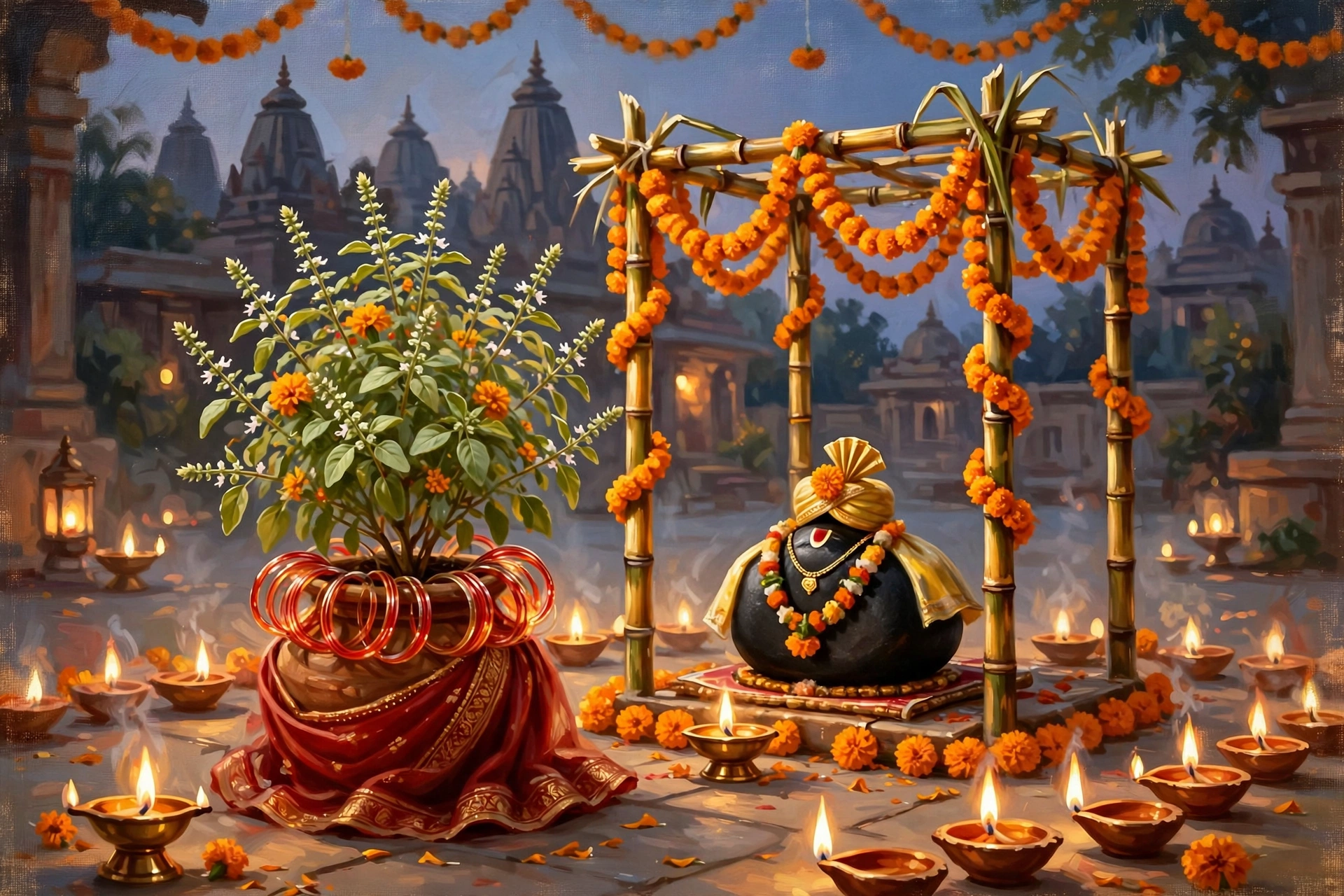
In the third week of November, something quietly beautiful happens in Hindu courtyards across the country. The tulsi plant — the same one you water every morning — gets dressed up like a bride. A red chunri, glass bangles, a touch of kumkum. Beside her sits the Shaligram, a small black stone, dressed as the groom. A mandap of sugarcane goes up around them, someone starts singing, and for one evening your courtyard becomes a wedding house. That is Tulsi Vivah.
The story behind the wedding: Vrinda and the demon king
Every legend of Tulsi Vivah starts with a woman named Vrinda. She was a devoted wife and a fierce Vishnu bhakt, but she had the misfortune of being married to Jalandhar, a demon king who was terrorising the three worlds. Nobody could defeat him — not even Lord Shiva — because Vrinda’s pativrata dharma was so powerful that it made her husband invincible.
Finally, the gods went to Vishnu with folded hands. There was no way around it: Jalandhar could only be stopped if Vrinda’s vow of chastity was broken. So Vishnu himself took Jalandhar’s form and went to Vrinda. When she realised she had been deceived, her fury was terrible. She cursed Vishnu — that he would turn into a black stone, and that he would know what it is to be separated from his own wife.
Then, with her world shattered, Vrinda gave up her body in her husband’s funeral fire. Moved by her devotion even in her anger, Vishnu blessed her: she would take birth as the Tulsi plant, worshipped in every Hindu home, and he himself — as the black Shaligram stone — would marry her. That wedding is what we celebrate on Tulsi Vivah. And as for her curse, tradition says it came true in the Ramayana, when Vishnu as Ram was separated from Sita.
When is Tulsi Vivah in 2026?
Tulsi Vivah 2026 falls on Saturday, 21 November, on Kartik Shukla Dwadashi — the 12th day of the bright half of Kartik. The Dwadashi tithi runs through that Saturday, and most families perform the ceremony in the evening, after sunset.
There’s a small calendar nuance worth knowing. The day before, Friday, 20 November, is Prabodhini Ekadashi (also called Dev Uthani Ekadashi) — the day Vishnu wakes from his four-month Yoganidra, ending Chaturmas. Some families perform Tulsi Vivah on the Ekadashi evening itself, while most do it on Dwadashi. If you want to keep track of the exact tithi for your city, check the year-round Ekadashi dates on our site.
And yes — this is the day the wedding season reopens. Chaturmas ends, and families start finalising dates again. If your family has a wedding coming up, our auspicious marriage dates guide and the classic Kundli matching check are where most people begin.
How a simple home Tulsi Vivah goes
You don’t need a pandit, though many families call one. The courtyard tulsi — ideally growing in its own little shrine, the tulsi chaura — is bathed, then dressed like a bride: a small red saree or chunri, bangles, kumkum and haldi, flowers in “her” branches. A Shaligram stone (or a Vishnu idol, if you don’t have one) is placed beside her as the groom.
A mini mandap is made with sugarcane stalks, the two are joined with a sacred thread or a chunri, and then it proceeds like a real wedding — mantras, aarti, the women singing traditional vivah songs, haldi-kumkum offered to married women present, and prasad (usually sugarcane, jaggery and seasonal sweets) distributed to everyone. The ceremony is done in the evening, in the Pradosh period after sunset.
My honest opinion? Even if you’re not the ritual type, Tulsi Vivah is worth attending once just for the atmosphere — a whole lane of houses with their tulsi shrines lit up with diyas, everyone singing slightly out of tune, children fighting over the prasad. It’s one of the sweetest evenings in the Hindu calendar.
Why families take it so seriously
For married women, Tulsi Vivah is prayed for the husband’s long life and the family’s well-being — the kanyadaan performed here is said to carry the merit of a real daughter’s wedding. For unmarried girls, the tradition holds that praying to Tulsi on this day brings a good husband; it’s one of those vows mothers pass down to daughters with full conviction.
There’s also a practical reason so many real weddings get fixed on this day: it’s considered deeply auspicious for marriages and engagements. Couples who marry on Tulsi Vivah are believed to receive Vishnu and Lakshmi’s own blessing on their union.
If you’d like to add some reading to the evening, our Sanatan Shastra library has the full Vishnu stotra collection — the Vishnu Sahasranama and Satyanarayan Katha sit naturally with this festival’s mood.
Quick answers
Is Tulsi Vivah on Ekadashi or Dwadashi?
Both, depending on family tradition. Ekadashi (20 Nov 2026) is Prabodhini Ekadashi, when Vishnu wakes; Dwadashi (21 Nov 2026) is when most of India performs the actual wedding ceremony in the evening.
Can I schedule my wedding on Tulsi Vivah?
Traditionally yes — it’s one of the most auspicious days for weddings and engagements, marking the reopening of the marriage season after Chaturmas. Just run the usual checks (pandit, muhurat, gun milan) alongside.
What if I don’t have a Shaligram stone?
It’s fine — many families use a Vishnu or Krishna idol, or even a coconut dressed as the groom. The devotion matters more than the prop.