 Shrimad Astro

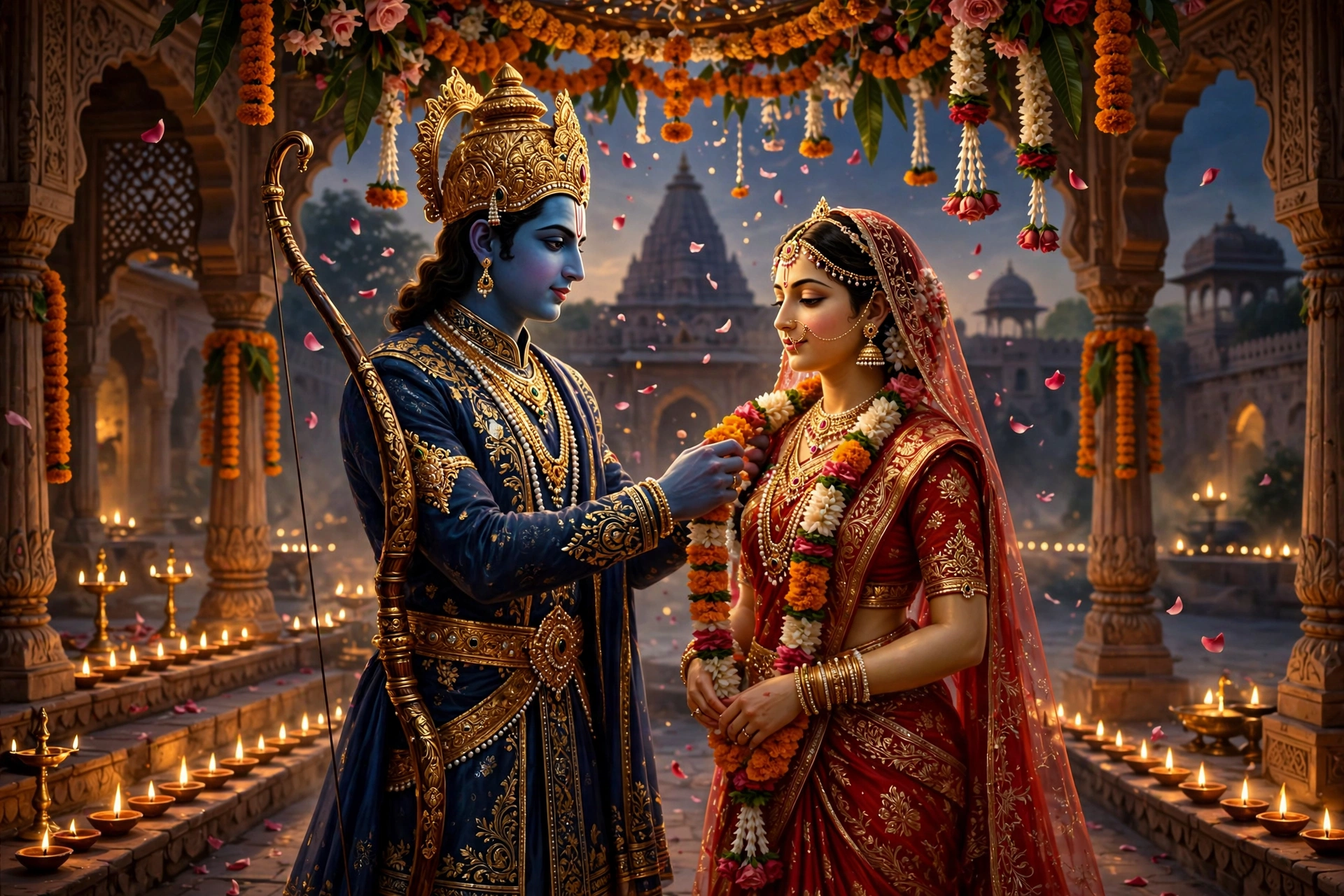
Vivah Panchami 2026: the date
Vivah Panchami falls on Monday, 14 December 2026 — the Panchami (fifth day) of the waxing moon in the month of Margashirsha. The Panchami tithi itself runs from Sunday evening (about 4:47 PM on 13 December) to Monday evening (about 7:15 PM on 14 December), and because the tithi covers Monday’s sunrise, the festival is observed on Monday across India. If you track festival dates through the year, the Hindu calendar page lists every vrat and festival with their tithis.
The story: a swayamvar, a bow, and four weddings
King Janaka of Mithila (today’s Mithilanchal, spread across Bihar and Nepal) was ploughing a field during a yajna when he found a baby girl lying in the furrow itself. He raised her as his daughter and named her Sita, “the furrow.” As a child, she was already extraordinary: legend says she once lifted Shiva’s great bow, the Pinaka, that even grown warriors couldn’t move.
So when Sita came of age, Janaka set a condition no ordinary prince could meet — whoever could string the Pinaka would win Sita’s hand. Kings arrived from everywhere. One after another they heaved, strained, and failed. Then Rama, the young prince of Ayodhya who had wandered into Mithila with his guru Vishvamitra, stepped forward. He lifted the bow with ease — and while drawing it, snapped it clean in two. The wedding was fixed.
It wasn’t just one wedding. On Vivah Panchami, all four of Dasharatha’s sons married daughters of Mithila’s royal family in a grand ceremony at Janakpur: Rama married Sita, Lakshmana married Sita’s sister Urmila, Bharata married Mandavi, and Shatrughna married Shrutakirti (Mandavi and Shrutakirti were the daughters of Janaka’s younger brother Kushadhvaja). The barat returned to Ayodhya amid celebrations that lasted days.
How Janakpur and Ayodhya celebrate today
The two cities tied to the couple still celebrate like it’s a family wedding. In Janakpur, Nepal, the Janaki Mandir becomes the centre of a week-long festival. Idols of Ram and Sita are dressed as a bride and groom — jewellery, garlands, the works — and carried in a massive barat procession while devotees sing marriage songs and play dholak. In Ayodhya, temples set up tableaux of the wedding, light up the ghats, and host all-night Ramleela performances re-enacting the swayamvar.
At home, the celebration is simpler but just as heartfelt. Devotees place the idols of Ram and Sita together on a small chowki, bathe them in Gangajal, dress Ram in yellow and Sita in red, and offer shringaar items — bangles, sindoor, garlands. Many families read the Bal Kanda of Tulsidas’s Ramcharitmanas, which describes the wedding in joyful detail; you can read the full Ramcharitmanas and the Ramayana’s 108-verse summary, Nama Ramayanam, in our Sanatan Shastra library, or sing along with the Nama Ramayanam lyrics page. Many married couples fast through the day praying for harmony in their marriage, and unmarried women keep the vrat praying for a worthy life partner.
The rule that surprises everyone
Here’s the twist that catches people off guard: though it celebrates a divine wedding, most families in Mithila traditionally do NOT hold their own children’s weddings on Vivah Panchami. The reason is love, not logic — Sita’s married life held so much suffering (the exile, the separation, the fire trial) that parents fear marrying their daughter on this day might invite similar hardship. It’s a popular belief, not a scriptural rule; several scholars point out that nothing in the shastras declares the day inauspicious for marriage. In recent years, some communities have even started holding collective weddings on Vivah Panchami to quietly challenge the old fear.
What the day IS considered excellent for: praying for an existing marriage and asking the divine couple’s blessings before fixing a new alliance. If you’re matching kundlis for a proposal, the Kundli Matching (guna milan) tool runs the traditional 36-guna check — and when you’re ready to fix a date, the auspicious marriage dates list and the muhurat helper will do the heavy lifting that pandits once did with a panchang.
FAQs
When is Vivah Panchami in 2026?
Monday, 14 December 2026 (Margashirsha Shukla Panchami). The tithi runs from Sunday evening to Monday evening, and Monday is the day of observance in India.
Where is Vivah Panchami celebrated most grandly?
Janakpur in Nepal (Sita’s birthplace, home of the Janaki Mandir) and Ayodhya in Uttar Pradesh (Rama’s birthplace). Both hold week-long festivities with barats, tableaus and Ramleela.
Is Vivah Panchami a good day for weddings?
Surprisingly, no — at least by Mithila tradition. Families in the region avoid marrying on this day because of Sita’s difficult married life, though this is a regional belief rather than a scriptural rule. The day is, however, considered excellent for praying for marital harmony and for starting a marriage search.