 Shrimad Astro

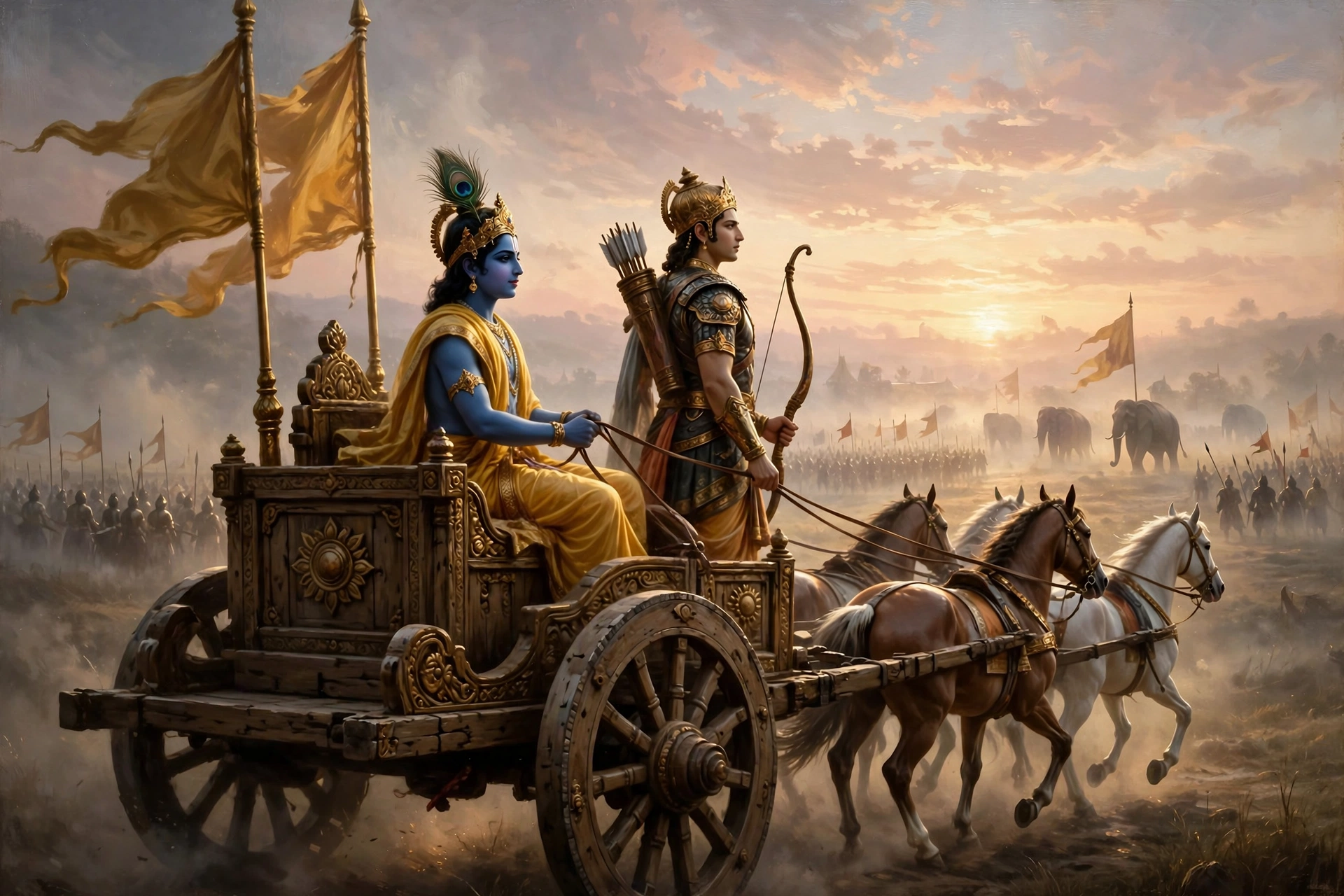
The morning the conch shells fell silent
Picture it: dawn on the plains of Kurukshetra. Two vast armies facing each other, the conch shells just sounded, and Arjuna — the greatest archer of his age — turns to the man holding his chariot’s reins and says, in effect: drive me into the middle. Let me see who has actually come to fight.
What Arjuna saw between those armies broke him. Across the field stood his grandsire Bhishma, his teacher Drona, his cousins, his uncles — men he had bowed to every morning of his life. His bow, the famous Gandiva, slipped from his hands, and he sat down in his chariot and refused to fight.
That is the moment the Bhagavad Gita begins — not in a quiet ashram, but in a war chariot between two armies about to kill each other. This December, on Sunday, 20 December 2026 — Mokshada Ekadashi of Margashirsha — devotees mark the 5,163rd Gita Jayanti by the traditional count, the day Krishna answered Arjuna’s despair with 700 verses the world has never stopped quoting.
Why a battlefield, of all places?
Here’s what most people miss: Krishna didn’t tell Arjuna to walk away — the easy spiritual answer, drop the bow and go meditate in the forest. Instead Krishna told him to pick the bow back up. Arjuna’s duty as a warrior was real, the injustice he was fighting was real, and running away would not have made him holy. It would have made him a coward with excuses.
That is why the Gita still works for ordinary people. Most of us will never sit on a Himalayan rock, but all of us have stood where Arjuna stood: knowing exactly what we must do and being unable to do it. Krishna’s answer was never meant for monks alone — it was given to a man with a job to do in the next ten minutes.
There is a lovely detail in how the story reaches us. Arjuna never wrote the Gita down — the blind king Dhritarashtra sat far away in Hastinapura, and his minister Sanjaya, granted distant sight of the battlefield by the sage Vyasa, narrated the whole conversation to him. So the Gita is, technically, a transcript overheard across a war. The Mahabharata carries it inside the Bhishma Parva, its sixth book.
18 chapters, 700 verses, three ways home
The Gita’s 700 shlokas fall into 18 chapters, and Krishna keeps circling three paths. Karma yoga — the yoga of action — says: Karmanye vadhikaraste, ma phaleshu kadachana (Gita 2.47). Your right is to the work alone, never to its fruits. Then jnana yoga, the path of knowledge, and bhakti yoga, the path of devotion.
If that sounds abstract, Chapter 2 alone is worth your evening: Krishna says equanimity — treating success and failure the same — is yoga. Honestly, half of modern self-help is a diluted paraphrase of Chapter 2. Panditji will tell you what my grandfather used to say: when in doubt, read Chapter 2 first. It previews the whole book.
And there is no bad translation — in Sanskrit, Hindi, English or Tamil (you can find all 18 chapters of the Bhagavad Gita in our Sanatan Shastra library). It was designed as speech, not as a monument.
How Gita Jayanti is observed
Gita Jayanti falls on Mokshada Ekadashi, the Shukla Ekadashi of Margashirsha — in 2026 the tithi runs from about 10:09 PM on Saturday, 19 December to 8:14 PM on Sunday, 20 December. Devotees typically observe the Ekadashi fast (see our Ekadashi date guide for fasting rules and parana timings), recite or listen to the Gita — many try all 18 chapters in one sitting — visit a Krishna temple in the morning, attend an evening aarti, and join Gita discourses or community satsangs.
A small suggestion for your first Gita Jayanti: don’t try all 700 verses in one go and burn out by lunch. Read one chapter slowly and let a single verse sit with you for the day. The Gita was spoken to a man in crisis, not to a scholar.
FAQs
When is Gita Jayanti in 2026?
Sunday, 20 December 2026 — Mokshada Ekadashi of Margashirsha (the 5,163rd Gita Jayanti by the traditional count).
How many chapters and verses does the Bhagavad Gita have?
18 chapters and 700 verses, carried inside the Bhishma Parva of the Mahabharata — each chapter traditionally treated as a separate “yoga”.
Do I need to know Sanskrit to read the Gita?
Not at all. Good translations exist in every major Indian language and in English — and since the verses were spoken aloud as counsel, listening to a recitation with translation counts just as much as reading.