 Shrimad Astro

First, the date and the moon you’re waiting for
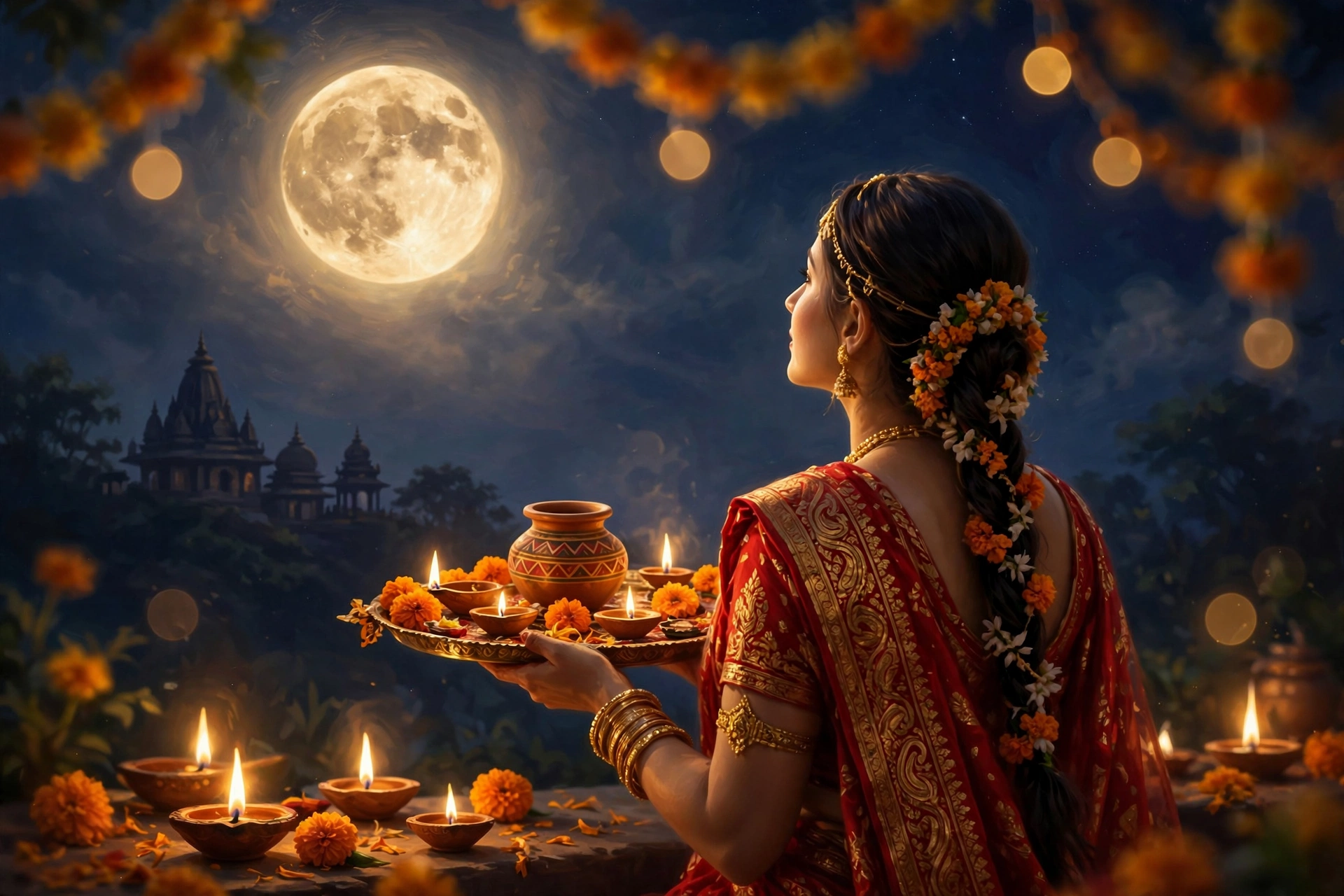
If you grew up in a north Indian home, you know this day by its sounds — a thali clinking at four in the morning, your mother-in-law urging one more spoonful of sevaiyan, and then, by evening, the whole terrace holding its breath for one pale circle to appear in the east. That is Karwa Chauth, and in 2026 it falls on Thursday, 29 October — the Krishna Chaturthi of Kartik, nine days before Diwali.
The name tells you the whole festival. A karwa is the small earthen pot with a spout at the centre of the puja; chauth is the fourth day of the waning fortnight. Everything that day — the fast, the puja, the water poured at the end — bends toward one event: the moonrise. In Delhi the traditional puja window is roughly 5:38 pm to 6:56 pm, with moonrise around 8:15 pm. Timings shift by city, so check your own city’s moonrise time, not a forwarded WhatsApp message.
The fast runs from sunrise (about 6:30 am in Delhi) to moonrise — roughly fourteen hours. Traditionally it is nirjala: not even water.
The katha: a queen, seven brothers and a mirror
Every Karwa Chauth gathering has that one auntie who knows the story by heart. There was a queen named Veeravati, the youngest of seven siblings. On her first Karwa Chauth she was wilting by evening, so her brothers climbed a peepal tree and held up a mirror through the leaves, faking the moonrise. She ate — and that very night, her husband died.
The traditional telling says she learned of the trick, begged the goddess for mercy, and was given one condition: keep the vow properly, the whole day, for a full year. She did — and at the next Karwa Chauth, under the real moon, her husband was restored to her.
That is why the panditji always ends it the same way: the vow has no shortcuts. A fake moon breaks it; only the real one ends it. One honest note: no Purana prescribes this vow — it is a folk observance carried by women’s communities, not by scripture. That doesn’t make it thinner. It makes it theirs.
The day, hour by hour
Sargi, before sunrise. The day begins in the dark. The mother-in-law sends — or brings — a thali: sevaiyan kheer, mathri, fruit, sometimes a sari tucked in. Eat before sunrise; once the sun is up, the fast is sealed. Every seasoned faster’s advice: take the protein, skip the extra sweets — they only make you thirstier by noon.
The day and the evening puja. Women dress up — bridal reds, yesterday’s mehndi, full shringaar. In the evening the neighbourhood gathers, each woman carrying her decorated karwa, and someone retells the vrat katha. Pots are exchanged, and the daughter-in-law offers her mother-in-law a baya — sweets, money, clothing — the repayment for the sargi. Then Shiva, Parvati, Ganesha and Kartikeya are worshipped together. Parvati is the heart of it — Nitya Sumangali, eternally free from widowhood, the example the whole vow is addressed to.
Moonrise. Through a sieve, the woman looks at the moon and offers it arghya — water poured from the karwa. Then, through the same sieve, she looks at her husband’s face. He puts the first sip of water and the first morsel of food in her hands. The fast breaks.
What it means today
Strip away the decorations and Karwa Chauth is an unusually honest festival — no ambiguity about the prayer: the long life of the person you chose, or who was chosen for you. In plenty of modern homes the husband keeps the fast too, or at least till the evening puja as a gesture.
It is also one of the rare festivals built around the Moon rather than the Sun — fitting, because in Vedic astrology the Moon rules the mind and emotions, and your Moon sign shapes your temperament far more than your Sun sign. You can get a free kundli at https://shrimadastro.com/janam-kundali and see where your Moon stood at birth.
My honest opinion: the fast is hard, and that’s the point. Fourteen hours without water buys you something real — a day of deliberate, undivided attention to your marriage. The sieve, the moon, the first sip of water from your husband’s hand: choreography for two people to look at each other with complete attention once a year. We could all use that.
Quick questions
Is water really not allowed?
The classical vow is nirjala, without water. But health comes first — if you’re pregnant, unwell, or on medication, keep a simple fast with water. No one worth listening to will call that cheating.
What if clouds hide the moon?
Traditionally the fast ends only on sighting; in cloudy weather most families go by their city’s published moonrise time.