 Shrimad Astro

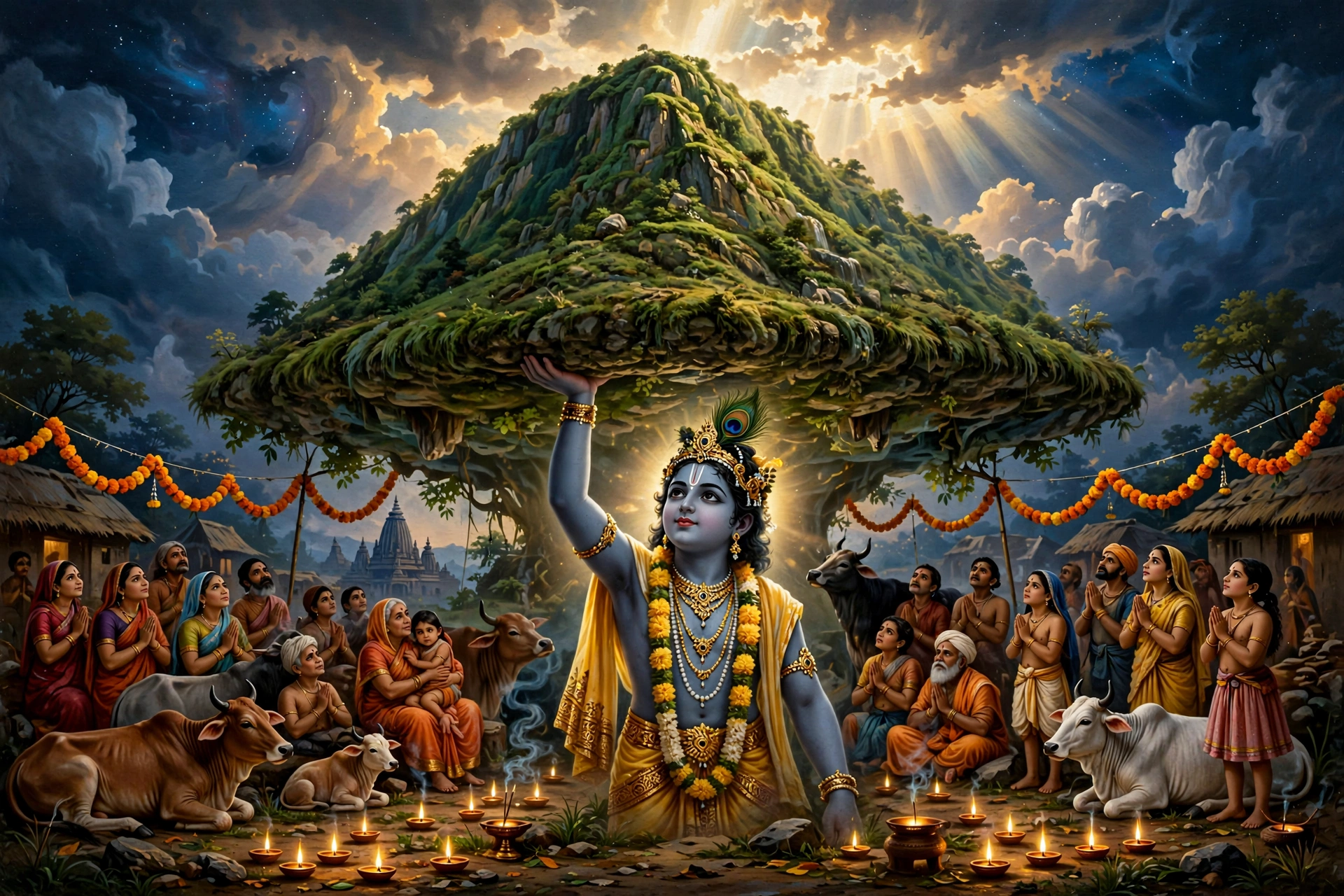
You’d think the biggest day of Diwali week is Lakshmi Puja — the diyas, the gold shopping, the whole neighbourhood glittering. But ask anyone from Braj, and the day that matters most comes the morning after: Govardhan Puja, when the festival turns its face away from the markets and toward a hill. Govardhan Puja / Annakut 2026 falls across 9–10 November (India): Kartik Shukla Pratipada runs from about midday on Monday the 9th to about 2 PM on Tuesday the 10th. The evening Annakut is observed on the 9th (drikpanchang), while the morning muhurat falls on the 10th — and it is the one festival built around a mountain of food. Here’s why.
The story: when Indra’s storm met a little finger
Every year, the cowherds of Braj would hold a grand yajna for Indra, the rain god — feasts, fires, the works — to keep the monsoons kind. Krishna, still a boy, watched all this and asked a very practical question: why are we thanking the fellow who sends rain, when our cows live off this hill? Govardhan gives us grass, water, shade and milk. Shouldn’t we thank the giver rather than the postman?
It made sense. The villagers redirected the sacrifice to the hill, the cows and the brahmins. Indra, as the Bhagavata Purana tells it (Canto 10, chapters 24–27), did not take it well. He sent down a week of furious rain and storm to drown Vrindavan.
So Krishna lifted Govardhan hill on his little finger and held it for seven days and seven nights, like a stone umbrella, while families and cattle sheltered underneath. Indra’s pride broke before the hill did.
Ever since, the day is kept as Govardhan Puja, and Giriraj is worshipped in Vaishnav tradition as Krishna’s own form — not just a hill where something happened. Krishna is also why Janmashtami is celebrated every year.
Annakut: the mountain of food
“Annakut” literally means a heap of grain — a mountain of food. The tradition says Yashoda fed Krishna eight times a day, and he went seven days without a bite under that hill. So when the storm passed, every household in Gokul cooked its best and piled it into a mountain before him: sweets, snacks, rice, milk preparations, fruits. Eight times seven is fifty-six, and that number stuck — chhappan bhog is still the heart of the offering.
It is also why the festival feels like Thanksgiving with diyas. In temples — Nathdwara, Mathura, Vrindavan, the big ISKCON centres — the spread is laid out before the deity in the shape of a hill, offered, and then handed out to everyone as prasad. One old pandit in Mathura told me the point is simple: food becomes sacred the moment it is shared. If you are looking for the aartis to sing at the offering, they sit in the devotional library.
How families keep it at home
You don’t need a temple. The old village way: shape a little Govardhan out of cow dung in the courtyard, dress it with grass, twigs and tiny cow figures, and circle it with the family. Offer what you’ve cooked — a full spread or just kheer and pooris — and share the prasad with everyone who comes. Nobody keeps a scorecard.
One timing note: Kartik Shukla Pratipada begins around midday on 9 November and runs till about 2 PM on 10 November. The traditional evening (sayankala) Annakut is observed on the 9th, while the morning (pratahkal) muhurat — 6:40–8:50 AM per the Delhi printed panchang — falls on the 10th. Follow your local panchang, since the exact window shifts from city to city. Check your city’s panchang rather than copying a time off a random reel. And if you are fasting for Lakshmi that week, the Sanatan Shastra library has the Sri Suktam and other wealth-related stotras to recite alongside the puja.
Same day, other names
Don’t be surprised if your Gujarati friend calls it Padwa and your Maharashtrian colleague says Bali Pratipada. The same lunar day carries a different story in the west and south — King Bali’s return is the best-known one — but the mood is identical: a day of renewal after Diwali’s worship of wealth. See the full five-day Diwali calendar to keep all five days straight.
FAQs
Is Annakut the same as Govardhan Puja? Yes. Govardhan Puja is the worship of the hill; Annakut is the mountain-of-food offering that goes with it. Same festival, same puja — across 9–10 November 2026 (evening observance on the 9th, morning muhurat on the 10th).
Why exactly 56 dishes? The tradition counts it this way: Yashoda fed Krishna eight times a day, and he went seven days without eating while holding the hill — eight times seven is fifty-six.
Can I do it if I can’t cook 56 dishes? Absolutely. The number is a symbol of abundance, not a minimum order. One dish made with devotion, shared with family — that is the whole point.