 Shrimad Astro

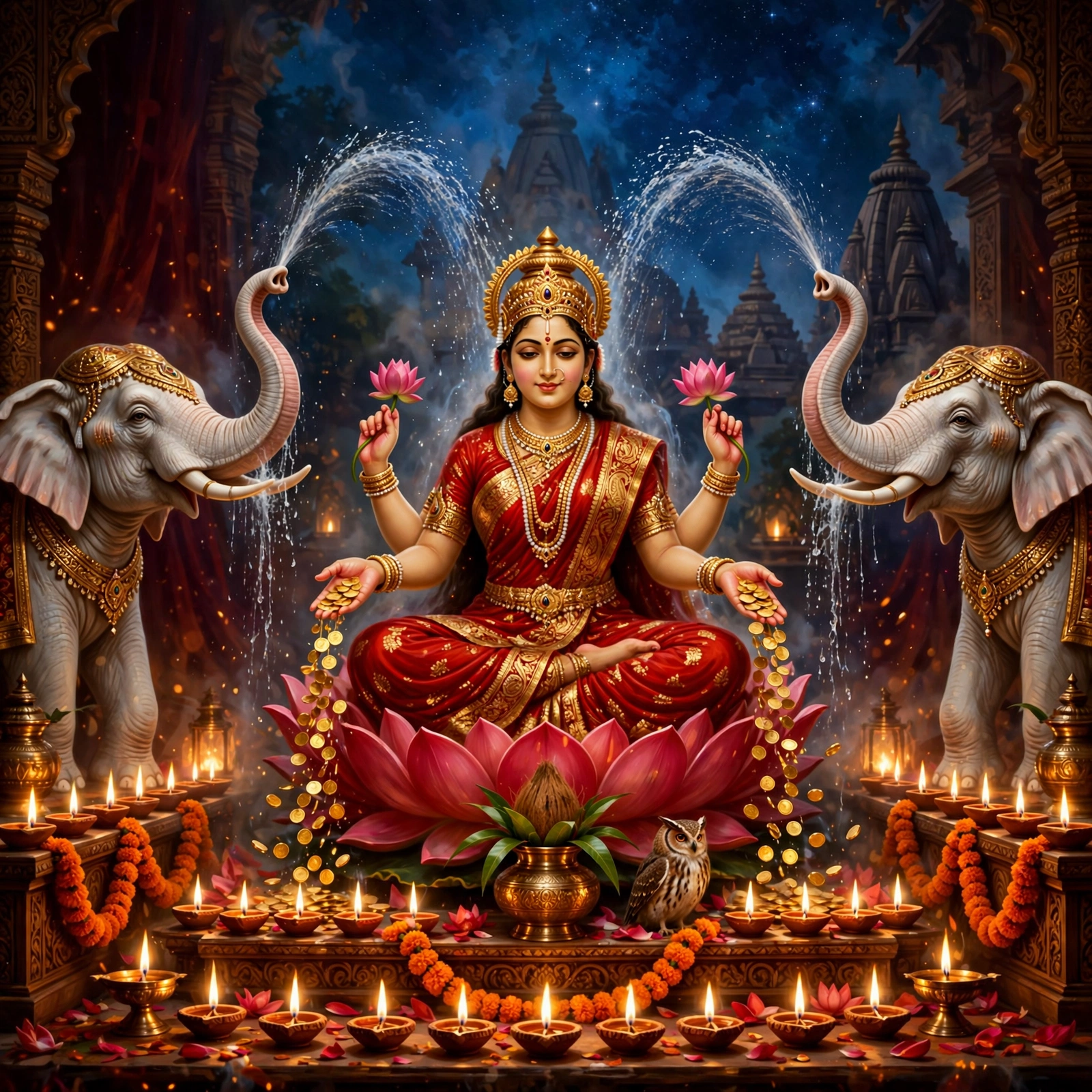
On Diwali evening the house smells of ghee, marigolds, and a faint whiff of crackers from the lane outside. Your grandmother has already asked twice, “Puja ka time ho gaya?” Here’s the honest answer — and a simple way to do the whole thing at home without a pandit.
When is Lakshmi Puja in 2026?
Diwali — the main night of Lakshmi Puja — falls on Sunday, 8 November 2026, on Kartik Amavasya. The tithi begins around 11:27 AM that Sunday and runs till about 12:31 PM the next day, so the whole of Diwali evening sits inside the new moon. First rule: Lakshmi Puja is an evening puja, not a morning one.
It lands in the middle of the five-day Deepavali festival: Dhanteras on Friday 6 November, Choti Diwali on the 7th, the main puja on the 8th, then Govardhan Puja and Bhai Dooj in the days that follow. Our Diwali 5-day calendar maps out the full festival.
The muhurat: why the exact hour matters
Ask any pandit when to do Lakshmi Puja and you’ll hear one answer: Pradosh Kaal — the twilight period just after sunset, when the Amavasya night is at its darkest. Tradition says this is when Lakshmi is most willing to enter a home. The ideal slice is the overlap of Pradosh Kaal with Vrishabha (Taurus) lagna — a sthir, fixed ascendant — so the goddess’s presence stays steady.
Here’s the part people get wrong: there is no single all-India time. Sunset shifts by up to an hour between cities, so the muhurat moves with it. For 2026, Delhi’s window is roughly 5:54 PM to 7:50 PM; Mumbai is around 6:27–8:27 PM; Kolkata around 5:20–7:18 PM. Never copy a timing forwarded from another city — check your own location, confirm the Amavasya tithi on our daily Panchang, and use Choghadiya to pick a shubh segment if you’re running late.
For the business families: trading households also do Chopda Pujan — the worship of new account books — often in the late Nishita Kaal near midnight rather than the evening window. Follow your family’s custom.
A simple puja vidhi at home (no pandit needed)
Set aside about an hour and do it with attention rather than hurry:
- Clean and decorate. Sweep the house properly — tradition holds that Lakshmi visits clean, well-lit homes. Put a rangoli at the entrance and line the doorway with diyas before you begin.
- Set the chowki. A low wooden seat covered with a red cloth, facing east. Lakshmi in the centre, Ganesha beside her (always worshipped first, to clear obstacles), and Saraswati if your family includes her. A kalash with mango leaves and a coconut goes behind.
- Invite the goddess. Sprinkle a little water around the altar, fold your hands, and invite Lakshmi into your home. A minute of quiet dhyana is the heart of the whole puja — don’t rush it.
- Snana and shringar. Bathe the idols with water and panchamrit (milk, curd, ghee, honey, sugar), then offer kumkum, haldi, akshat, a red thread, and fresh flowers — lotus or marigold.
- Dhoop, deep, naivedhya. Light incense and the main diya, wave them before the deities, then offer sweets, fruits, and whatever you’ve cooked. Home-made bhog matters more than anything store-bought.
- Mantra and aarti. Chant “Om Shreem Mahalakshmyai Namah” — 11, 21 or 108 times, whatever you have — then do the aarti standing. Our Lakshmi mantra collection has the longer prayers, and our Sanatan Shastra library has the Mahalakshmi Ashtakam and Sri Suktam.
- Light the house. After the aarti, place diyas in every room, at the tulsi, and at the main gate. The house should glow — that is the whole point of Deepavali.
Common mistakes to avoid
- Doing the puja at a random time. The window is the evening, not the afternoon. Plan dinner and fireworks around the muhurat, not the other way round.
- Copying a muhurat from another city. A Delhi timing is wrong for Mumbai. Check your own city.
- Starting with half the samagri missing. Gather everything the day before — hunting for kumkum while the muhurat ticks away is the classic Diwali comedy.
- Forgetting Ganesha. He clears the path. Skipping him is like throwing a party and forgetting to open the gate.
- Plastic flowers and broken diyas. Fresh flowers, whole diyas, real ghee or oil. The details are the devotion.
Frequently asked questions
Can I do Lakshmi Puja without a pandit?
Absolutely. The home puja has always been done by the family itself. A pandit adds grandeur, but sincerity counts for more than Sanskrit fluency.
What if I miss the muhurat?
Don’t panic. The whole Pradosh evening is auspicious; the Vrishabha window is the best slice, not the only one. A shorter puja later in the evening — or near midnight — is perfectly fine.
Do I need new idols every year?
Clay idols are immersed after the festival; metal ones are bathed and kept. Reusing a cherished family murti is perfectly fine.