 Shrimad Astro

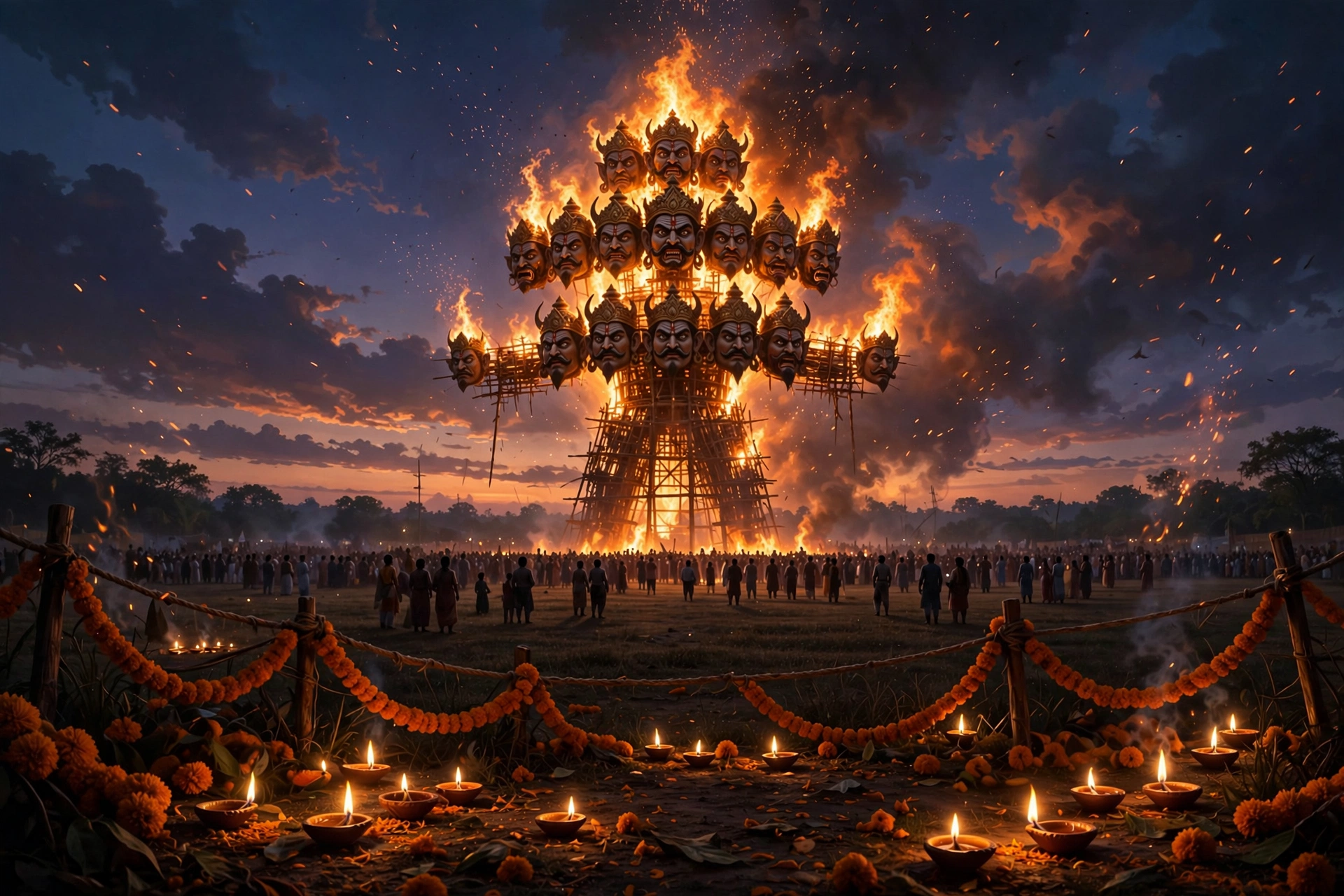
The Night We Set the Villain on Fire
Every October, thousands of people gather in open grounds across India and watch a giant, ten-headed demon burn. Kids sit on their fathers’ shoulders, vendors sell popcorn, and when the flames finally reach the paper crowns, the whole crowd cheers.
That night is Dussehra, also called Vijayadashami. This year it falls on Tuesday, 20 October 2026, the tenth day (Dashami) of the bright fortnight of Ashwin. But why do we burn Ravana at all — and why does an old tree get worshipped on the same day? Both questions have answers worth knowing before you go stand in the crowd.
Why We Burn Ravana
In the Ramayana, Ravana — the ten-headed king of Lanka — kidnapped Sita, Lord Rama’s wife. Rama fought him for ten days and killed him on Dashami. That’s where the name comes from: dasha (ten) + hara (defeat) — the defeat of the ten-headed one.
The burning we watch today is the finale of the Ramlila, the folk theatre that plays out Rama’s life from the first day of Ashwin’s bright fortnight. On the last evening, giant effigies of Ravana, his brother Kumbhakarna and his son Meghnad are set up in the mela ground and torched as thousands watch. It’s not mindless spectacle: no matter how ten-headed and undefeated evil looks, it goes up in smoke in the end.
Many people read the ten heads as ten bad qualities we carry inside — ego, anger, greed, attachment, and the rest. It’s a yearly reminder to burn our own Ravanas.
Actually, There Are Two Victories on This Day
Dussehra has a second story running underneath the first. In the Devi Mahatmya, Maa Durga fought the buffalo-demon Mahishasura for nine days and nine nights and defeated him on the tenth. Those nine nights are the Navratri that leads into Dussehra — each night honouring one of her nine forms. Vijayadashami, from vijaya (victory) and dashami (tenth), celebrates her triumph.
So the same tenth day honours Rama’s victory in the north and Durga’s victory in the east. Two epics, two villains, one conclusion: good wins, but only after a real fight.
The Shami Tree the Pandavas Trusted
Now for the quieter ritual. On Dussehra morning, many families worship a Shami tree — a hardy, thorny tree whose tiny leaves are exchanged between people as sone, symbolic gold, with wishes for prosperity.
The Mahabharata explains why. Before their thirteenth year of exile — the year they had to live in disguise — the Pandavas hid their bows and swords in the hollow of a Shami tree outside King Virata’s city. A year later, when the Kauravas attacked Virata’s cattle to smoke them out, the Pandavas retrieved their weapons from that tree, revealed their true identity, and defeated the attackers on this very day. Since then, the tree has been honoured as the keeper of their victory.
Alongside Shami Puja, the panchang lists two other rituals for the day — Aparajita Puja and Seema Avalanghan (crossing the border), the old custom of kings setting out on new campaigns once the war season began. For us today, the simpler version works: worship the weapons of your own trade. Writers open a fresh notebook, students place their books before the deity, and mechanics bless their tools.
When and How to Celebrate
The heart of Dussehra worship falls in the afternoon, during what the panchang calls the Aparahna window. The auspicious Vijay Muhurat falls roughly between 2:00 and 3:00 in the afternoon on 20 October — timings shift by city, so check your local panchang if you want precision.
Practically, here’s how the day usually flows. Morning: the Shami tree puja, or visiting your local temple. Afternoon: if you’re beginning anything new — a new business, a course, even a new book — the Vijay Muhurat is one of the few windows in the year considered auspicious enough to start without consulting an astrologer. Evening: the Ramlila ground, the effigies, and the fire.
If you’ve been putting off a new beginning, Dussehra is the day to take it — you can check your free kundli to see which planetary period is running for you.
Quick Answers
Why is it called Vijayadashami? From vijaya (victory) and dashami (the tenth tithi). It marks Rama’s victory over Ravana and Durga’s victory over Mahishasura, both on the tenth day.
Is Dussehra the same as Dasara? Yes — same festival, different regional spellings. In Nepal it is celebrated as Dashain.
What should I not do on Dussehra? Traditionally, the big new beginnings are timed for the Vijay Muhurat in the afternoon, since it’s one of the few windows in the year considered auspicious enough to start a venture without consulting a panchang.
Related: Read our complete Sharad Navratri 2026 guide covering the 9 goddesses, fasting rules and puja vidhi.