 Shrimad Astro

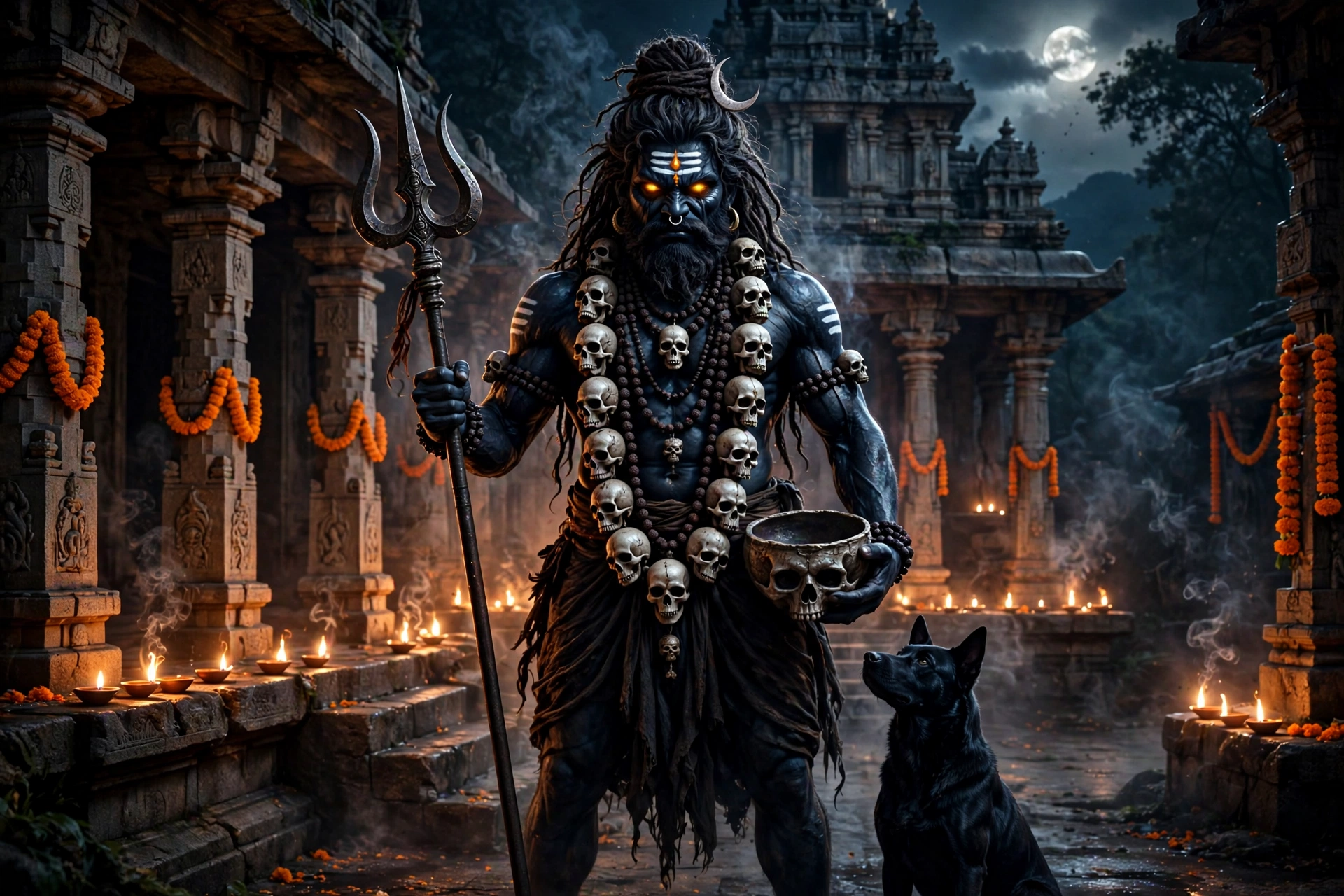
Most gods greet you with a smile and an open palm of blessings. Kaal Bhairav greets you with a garland of skulls, a trident, and a black dog sitting alert at his feet — and yet, in Banaras, people love him with an almost fierce tenderness. They say no one enters Kashi without his permission. His birthday, Kalabhairav Jayanti, falls this year on Tuesday, 1 December 2026 — one of the rare festivals kept at night, when the temples stay open late and the oil lamps burn till the early hours.
The Night Shiva Lost His Temper
Every family has that one story retold at gatherings with a mixture of pride and mischief. In Kashi, the Bhairava story is told like that. Once, the gods fell to arguing about who was supreme. Brahma, then proud of his five heads, spoke down to Shiva himself. Shiva opened his third eye, and out came a terrifying figure — Bhairava — who, with a single fingernail, sliced off Brahma’s fifth head.
Now here’s the part the pandits love: the skull stuck to Bhairava’s hand. Killing Brahma, the first priest, is the gravest of sins, and even a god could not shrug it off. Bhairava wandered the three worlds carrying the skull as his begging bowl, searching for release. It happened only when he stepped into Kashi. The moment his foot touched the city’s soil, the skull fell — at the spot still called Kapal Mochan. Shiva then made him the Kotwal of Kashi, the city’s eternal guardian. Even today, serious pilgrims seek his permission before anything else in Banaras.
Why This Day Matters
Kalabhairav Jayanti is observed on the Ashtami tithi of the dark fortnight of Kartik–Margashirsha, and in 2026 that is Tuesday, 1 December. It is a night festival: devotees fast through the day and worship after dark, when many Bhairava temples hold a midnight aarti. Since tithis shift slightly by city and sunrise, it’s worth checking today’s panchang near the date for the exact Ashtami timing where you live.
Most devotees, honestly, don’t wait for December. Every month, the Krishna Paksha Ashtami is Kalashtami — a smaller monthly version of the same vrat. If you’d like to keep it, you can follow the Masik Kalashtami dates through the year.
How People Actually Worship Him
There is nothing fancy about it, which suits him. On Jayanti day, people wake before sunrise, bathe, and many keep a simple fast — some strict, some on fruit and milk. In the evening the puja begins: black sesame seeds, mustard oil, flowers and coconut offered before his murti or picture, and a mustard-oil diya lit at the doorstep as darkness falls.
Then come the words. The Kalabhairava Ashtakam, the famous eight-verse hymn composed by Adi Shankaracharya, is recited in temples and homes across India — you can read it in our Sanatan Shastra library. His seed mantra, chanted through the night, is simply “Om Kalabhairavaya Namah”.
And then the part everyone knows him for: feed a black dog. Bhairava’s vahana is a black dog, and feeding dogs — especially black ones — with roti, milk, jaggery or sweets is considered his favourite offering.
The great centres of the night are Varanasi, where his temple stays open late into the Jayanti, and Ujjain, whose famous Kaal Bhairav temple also draws enormous crowds.
What He’s Actually the God Of
Kaal means time — and death. Kaal Bhairav is the Lord of Time, the fierce face of Shiva that stands at the edge of everything temporary. Traditionally, his worship is believed to burn away fear, protect against negative energies, and steady the harsher planetary periods — especially the afflictions of Shani and Rahu. If Saturn has been heavy on you, it’s worth checking where you stand in your Shani Sade Sati phase; Kaal Bhairav is the deity people turn to when Shani and Rahu refuse to budge.
My honest take: he is the god of facing things. Fear, endings, deadlines, the ticking clock you pretend not to hear. A night spent in his name is really about looking at what scares you — and finding that it flinches first.
Quick Answers
When is Kalabhairav Jayanti in 2026?
Tuesday, 1 December 2026, on the Krishna Paksha Ashtami of Kartik–Margashirsha. It is observed at night, with the main puja after dark.
Why do devotees feed black dogs?
A black dog is Bhairava’s vahana, his divine vehicle. Feeding dogs on Kalashtami is treated as a direct offering to him.
Is his worship only for tantrics?
Not at all. Anyone can worship Kaal Bhairav. The tradition favours simplicity and sincerity over elaborate ritual — a diya, a mantra, and a fed dog are more than enough.