 Shrimad Astro

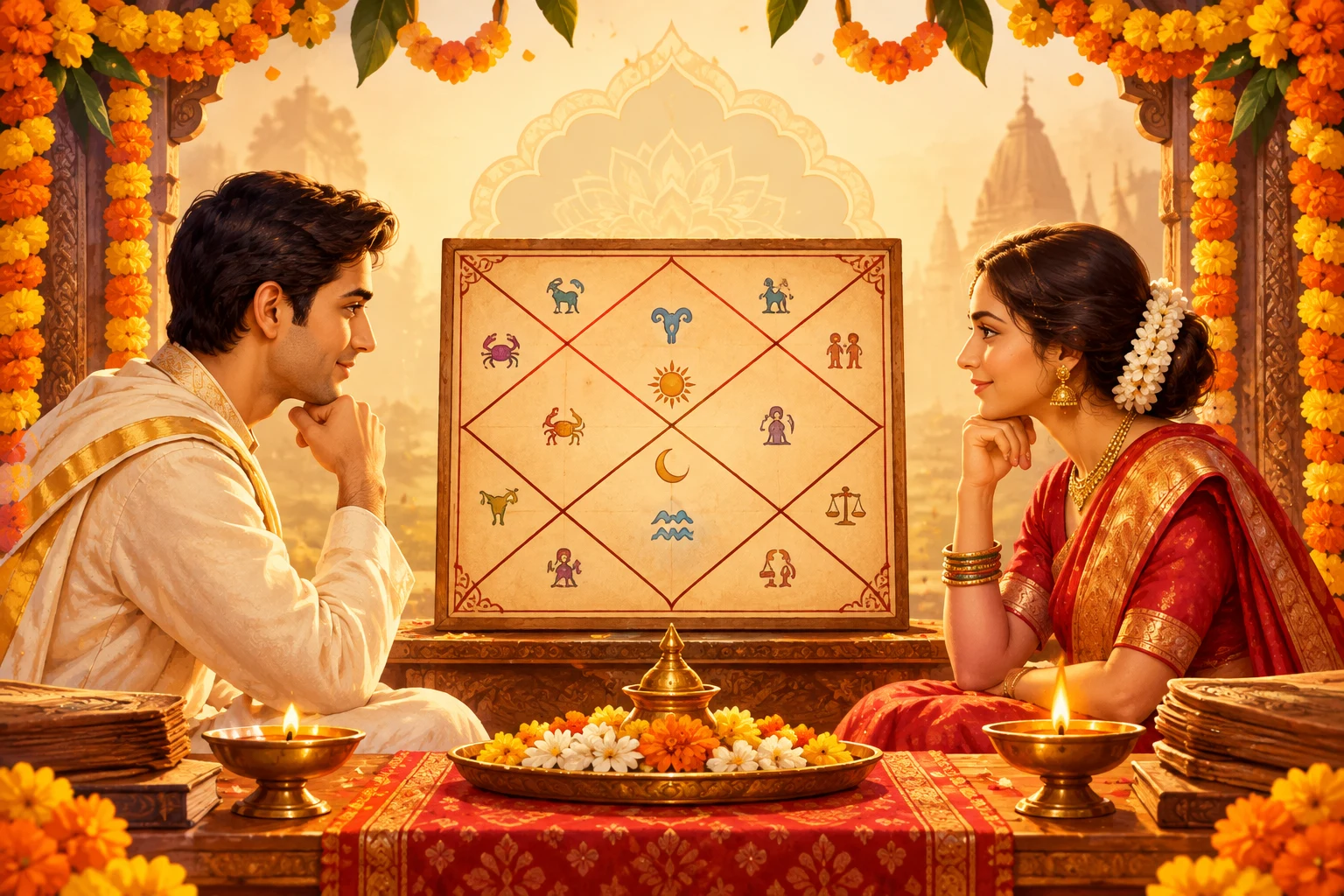
If you’ve ever sat through an Indian wedding negotiation, you know the scene. Two families, endless cups of chai, and at some point someone says it: “pehle kundli milwa lete hain.” Let’s get the horoscopes matched first.
It’s so routine that most of us never stop to ask — what exactly is being matched? And does a low score really mean the marriage is doomed? Here’s the full picture, without the jargon.
What Is Kundli Milan, Really?
Kundli Milan is the Vedic practice of comparing two birth charts to judge marital compatibility. Not sun signs — that’s newspaper astrology. A real matching studies the exact planetary positions at each person’s birth, with special weight given to the Moon.
The idea is old — really old. The method comes from classical Jyotish texts, most famously the Brihat Parashara Hora Shastra, attributed to Maharishi Parashara. For thousands of years, this was how families answered a simple question: will these two people be able to build a life together?
The comparison runs across eight dimensions called the Ashta-Koota. Each one scores points, 36 in total. That score is what everyone means by “gun milan.”
Here’s what most people get wrong: the score is not a prediction of divorce. It’s a measure of natural harmony — how much friction the relationship starts with, and where. Two people with a modest score and a lot of mutual respect will outlast a high-scoring couple that stops talking to each other. The chart shows the weather; you still have to sail the ship.
Why Families Treat It Like a Non-Negotiable
To understand why gun milan carries so much weight, you have to understand what marriage means in the Indian context. It’s not just two individuals pairing up — it’s two families, two lineages, two sets of ancestors joining together. The kundli is seen as a kind of character certificate issued by the cosmos itself.
There’s also a practical side nobody talks about. In arranged setups, families often know very little about the other person. The kundli becomes a structured way to ask difficult questions — about temperament, health, finances, longevity — without it feeling personal. “The chart says so” is easier than “we’re worried about your son’s temper.”
Does that make it scientific? Not in the laboratory sense. But dismissing it entirely misses why it has survived this long: it forces a conversation about compatibility before the wedding, not after.
The 8 Kootas: 36 Points That Decide Compatibility
Each koota checks one dimension of the partnership. Here’s the full breakup — this is the part panditji is actually calculating when he goes quiet with his pen:
| Koota | Points | What it actually checks |
|---|---|---|
| Varna | 1 | Whether you respect each other’s values and nature |
| Vashya | 2 | Natural attraction and mutual influence |
| Tara | 3 | Health, wellbeing and longevity of the partnership |
| Yoni | 4 | Physical and intimate compatibility |
| Graha Maitri | 5 | Mental friendship between the two Moon signs |
| Gana | 6 | Temperament — calm, fiery, or a mix that needs handling |
| Bhakoot | 7 | Emotional bonding; a weak score here gives astrologers pause |
| Nadi | 8 | Vitality, health of the couple and progeny — the most debated of all |
A quick note on the table: the points aren’t equal because the rishis didn’t consider every dimension equally important. Nadi gets 8 points because it concerns health and progeny — the things a family worries about most. Varna gets just 1, because mutual respect, while essential, was considered more a matter of upbringing than stars.
How the Points Actually Get Counted
The entire calculation rests on one thing: the Moon’s position at birth. Your Moon sign (rashi) and your birth star (nakshatra) decide almost everything in gun milan.
Take an example. If the bride’s Moon is in Rohini nakshatra and the groom’s is in Mrigashira, the astrologer checks a set of tables — how these two nakshatras relate across each of the eight kootas. Rohini–Mrigashira might score full marks on Tara but lose points on Yoni. Each koota has its own lookup, its own logic, refined over centuries.
This is also why the exact birth time matters so much. The Moon moves fast — roughly one nakshatra every single day. A birth time off by a few hours can shift the Moon into a different nakshatra and change the whole score. If your parents aren’t sure of your birth time, say so upfront. A good astrologer will do birth-time rectification first; a lazy one will just guess, and the entire milan becomes fiction.
What Counts as a Good Score?
The traditional passing mark is 18 out of 36. Cross 24 and families start smiling; cross 28 and wedding dates get discussed.
But the total can mislead. A 30-point match with Nadi dosha needs a harder look than a 22-point match that’s clean everywhere. Individual kootas — especially Bhakoot, Graha Maitri and Nadi — often matter more than the headline number.
Here’s an insider detail: experienced astrologers rarely reject a match on the total alone. They look at where the points were lost. Losing points on Varna (1 point)? Nobody cares. Losing all 8 on Nadi? That’s a long conversation. The distribution tells the real story — the total is just the headline.
The 3 Doshas That Matter More Than the Score
Mangal Dosh — Mars placed in the 1st, 2nd, 4th, 7th, 8th or 12th house. Real, common, and far less scary than WhatsApp forwards claim. What the forwards don’t tell you: the classical texts list a whole set of cancellations. Mars in its own or exalted sign? Cancelled. Both partners Manglik? Balanced out. Mars aspected by a strong Jupiter? Softened. In practice, a large share of so-called Manglik matches get cleared on a proper reading. If you want to check your own chart, our free Mangal Dosh calculator does it in seconds.
Nadi Dosha — both partners sharing the same Nadi. The texts treat it as the most serious of the matchmaking doshas, linking it to health and progeny. But entire schools of thought exist on the exceptions: same rashi but different nakshatra, same nakshatra but different pada — each changes the verdict. This one deserves a proper astrologer with both full charts open, not a five-minute app verdict.
Bhakoot Dosha — awkward Moon-sign pairings, the 6th–8th combinations (shad-ashtaka). The concern is emotional friction that compounds quietly over years. Worth an honest conversation, not panic — and notably, some traditions consider it cancelled when the lords of the two Moon signs are mutual friends.

A dosha is a flag for deeper analysis — and where genuine, for remedies. It is not a verdict.
When the Score Comes Out Low
So the panditji looks up from his calculations, and the number is 14. The room goes quiet. What now?
First: don’t panic, and don’t let anyone else panic either. A low score is the beginning of a proper analysis, not the end of the relationship. Here’s what actually happens in a competent astrologer’s office.
They check for cancellations. Many doshas have classical exceptions — the texts are full of “but if…” clauses that apps and hasty readings skip entirely. A surprising number of supposedly bad matches get rehabilitated right here.
They look beyond the Ashta-Koota. Gun milan is only one tool in the box. A thorough matching also examines the 7th house (marriage) and its lord in both charts, the Venus–Mars dynamic between the two people, the D-9 Navamsha chart — which many experienced astrologers consider more important than the birth chart for marriage — and the dasha sequences both people are currently running. Two people with 16/36 who are both entering a strong Jupiter period are a very different proposition from what the number alone suggests.
They prescribe remedies where appropriate. For genuine Mangal dosha: Hanuman worship on Tuesdays, specific fasting protocols, charity on defined days, and in certain cases Kumbh Vivah. These aren’t magic erasers — they’re disciplines meant to pacify the planetary influence and, frankly, to build the couple’s own commitment muscle. A couple that does remedies together has already started practising the teamwork marriage needs.
And sometimes, honestly? The astrologer says the match is genuinely difficult, and the families decide with open eyes. That’s also a valid outcome. An informed decision is always better than a blind one — in either direction.
My Honest Take
Gun Milan is a tool, not a judge. The classical texts themselves treat it as one input among many, and the couples I’ve seen thrive are the ones who used the score to start honest conversations — not the ones who treated it as a permission slip.
If I could give one piece of advice to anyone staring at a score right now: use it the way it was designed to be used. Let it tell you where the friction points might be — temperament, health, in-laws, finances — and then talk about those things directly, like adults. The chart can point at the potholes. Only the two of you can decide to drive carefully.
Curious where you stand? Our free Kundli Matching calculator computes all eight kootas in seconds, with dosha analysis included. And if you don’t have your birth chart handy, start with a free Janam Kundali first. Take the number — then talk to someone you trust. Both matter.
Frequently Asked Questions
What is the minimum Gun Milan score needed for marriage?
Tradition sets the bar at 18 out of 36. But treat that as a starting point, not a verdict — a clean 20 can be better than a troubled 30. The individual kootas, especially Nadi, Bhakoot and Graha Maitri, deserve as much attention as the total.
Can a low Kundli Milan score be “fixed”?
The score itself is just arithmetic — what can be addressed are the underlying doshas. Mangal Dosh, for instance, has well-established remedies from Kumbh Vivah to Hanuman worship. But no remedy changes the score; remedies pacify the planetary influence the score is flagging.
Is Nadi Dosha really a dealbreaker?
Classical texts treat it as the most serious of the matchmaking doshas — but they also describe exceptions and cancellations. Whether it applies to a specific couple needs a qualified astrologer looking at both full charts, not a one-line app verdict.
Do both partners have to be Manglik to marry?
No. When both are Manglik the dosha is traditionally considered balanced, but a Manglik marrying a non-Manglik is not automatically a problem. The strength of Mars, its sign, and the rest of the chart decide how much it actually matters.
Can I trust online Kundli matching calculators?
For the mathematics — absolutely. Computing 36 points across eight kootas is exactly what software does well. What calculators can’t do is interpret: weighing a weak Bhakoot against a strong Graha Maitri, or judging whether a dosha cancellation applies. Use the tool for the number, and a human astrologer for the meaning.
What if our exact birth times aren’t known?
Then say so before the matching, not after. The Moon moves through a nakshatra roughly every day, so even a few hours of uncertainty can shift the entire score. A competent astrologer will do birth-time rectification — working backwards from life events to estimate the correct time — before calculating anything. Any milan done on a guessed time is guesswork dressed up as precision.