 Shrimad Astro

What “Pradosh” actually means
Twice every month, on the 13th lunar day — Trayodashi — Shiva devotees fast through the day and do their puja not in the morning, but at dusk. This is Pradosh Vrat: Pra means remover, Dosha means faults or negative karma. The vrat is the remover of faults — past mistakes, heavy karma, the quiet baggage we all carry.
It falls on Trayodashi of both fortnights, waxing and waning — about 24 times a year. What sets it apart from morning fasts like Ekadashi is the timing: the puja happens during Pradosh Kaal, the twilight window of roughly 1.5 hours before and after sunset. For exact city-wise timings, see our full Pradosh Vrat date list — or check today’s panchang first.
The story: the poison and the dance at dusk
During the Samudra Manthan, the churning of the milk ocean, a terrible poison called halahala rose before the nectar of immortality. Shiva drank it to save creation — during this very twilight hour — while Parvati held his throat so it could go no further. That is how he became Neelakantha, the blue-throated one.
When the nectar then surfaced, the devas celebrated wildly — and forgot to thank the god who had made their victory possible. On Trayodashi they returned to beg forgiveness, and Shiva, in the evening hour, danced between the horns of his bull Nandi. That twilight of forgiveness became Pradosham. The Skanda Purana’s vrat katha adds that the sage Sandilya Muni prescribed this fast to a Brahmin woman and her two boys — and within eight Pradoshs their fortunes turned completely. Devotees still recite it during the evening puja, often alongside the Sri Rudram from our Sanatan Shastra library, a hymn the tradition links to exactly this hour.
The weekday gives each Pradosh its own flavour
Most casual observers miss this: the weekday on which Trayodashi falls decides what the Pradosh is “for”:
- Soma (Monday) — wishes fulfilled, mental peace, family harmony; couples praying for children, unmarried women seeking a good husband.
- Bhauma (Tuesday) — debts, disease, enemies; courage. Mars-linked troubles are brought to Shiva here.
- Saumya (Wednesday) — knowledge, education, communication; the student’s Pradosh.
- Guru (Thursday) — wisdom, teachers, ancestral blessings, protection from fate’s obstacles.
- Bhrigu (Friday) — wealth, marital bliss, domestic happiness.
- Shani (Saturday) — the heavy hitter: Saturn’s pressure, Sade Sati, karmic setbacks. Many light a sesame oil lamp and chant “Om Sham Shanicharaya Namah” alongside Shiva’s names.
- Bhanu (Sunday) — health, vitality, fame and progress in leadership.
Honest opinion: Soma and Shani Pradosh draw the biggest temple crowds, and that says something real about what people carry. If Saturn is testing you, mark the Shani Pradosh instead of just worrying. And since Shiva danced between Nandi’s horns that first evening, Nandi is worshipped during Pradosh puja too. Another evening-timed fast is coming up soon: Karwa Chauth on 29 October, covered in our Hindi flagship vrat guide.
Keeping the vrat at home, simply
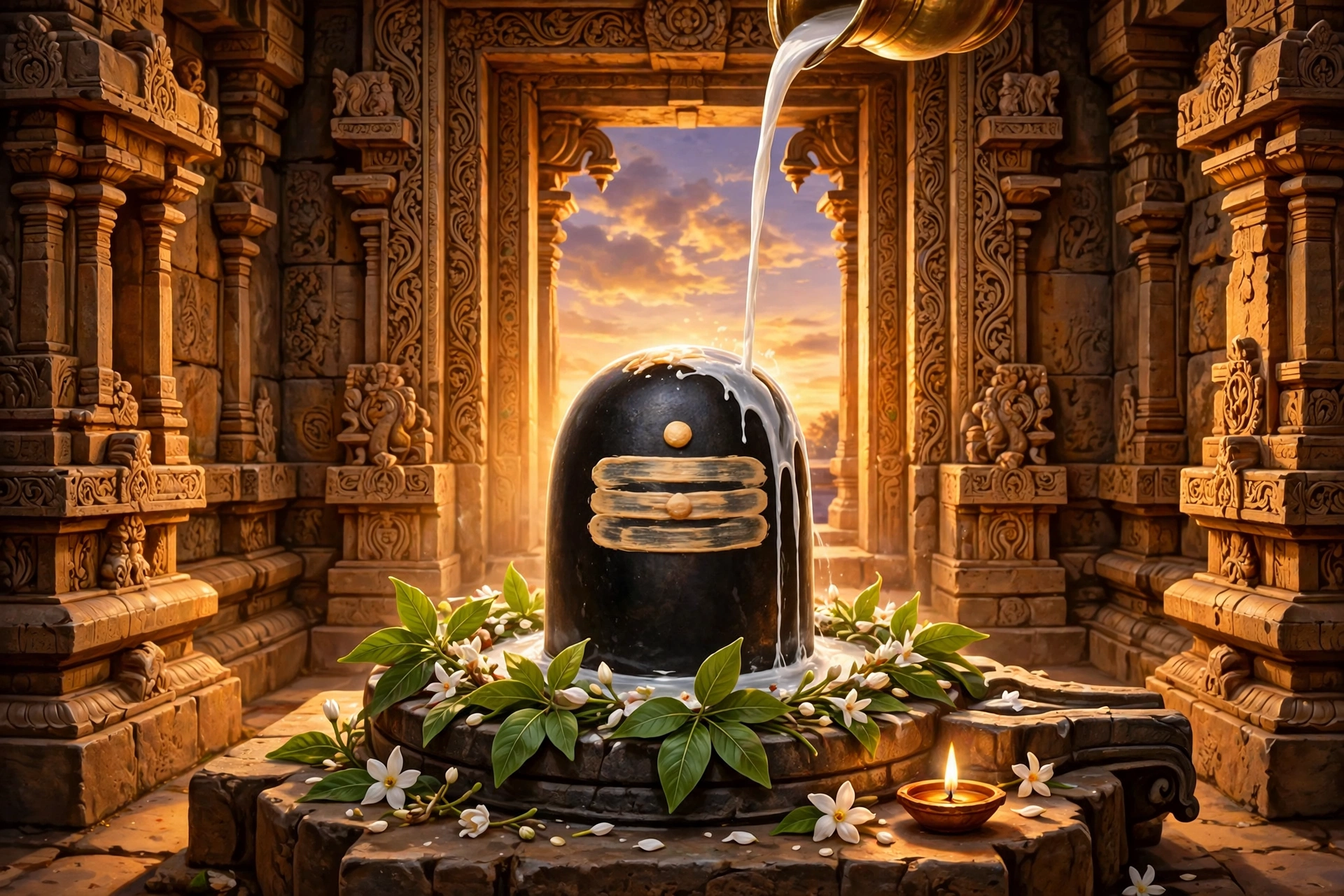
No priest needed — householders have done the whole vidhi themselves for generations. Morning: bathe, wear clean clothes, and take a sankalpa — a short spoken vow to keep the day for Shiva. Fast at your capacity (strict nirjala or fruit-and-milk phalahar), and avoid onion, garlic, non-vegetarian food and alcohol. Before sunset: bathe again, set up your Shiva lingam or photo with bilva leaves (sixteen is the traditional number, smooth side down), water, milk, curd, honey and ghee, white flowers, sandalwood paste, and a single ghee diya. During Pradosh Kaal: abhishekam — water, milk, curd, honey, ghee, finish with water — then the bilva leaves, “Om Namah Shivaya” 108 times, the Maha Mrityunjaya mantra if you can, the Shiv Chalisa or the vrat katha, and aarti. Break the fast after with prasad or a simple sattvik meal. If a Shiva temple is nearby, go — the temple Pradosh, with evening abhishekams and often a procession of Shiva and Parvati on Nandi, is a different experience entirely.
Upcoming Pradosh dates (verified)
Checked against AstroSage’s 2026 and 2027 Delhi panchang lists, with the Trayodashi-during-twilight overlap independently cross-verified on a Swiss Ephemeris calculation (Kaal timings approximate for Delhi):
- Fri, 23 October 2026 — Shukra Pradosh (Kaal ~5:44–8:16 PM IST)
- Fri, 6 November 2026 — Shukra Pradosh (Kaal ~5:33–8:09 PM IST)
- Sun, 22 November 2026 — Ravi Pradosh (Kaal ~5:25–8:06 PM IST)
- Sun, 6 December 2026 — Ravi Pradosh (Kaal ~5:24–8:07 PM IST)
- Mon, 21 December 2026 — Som Pradosh (Kaal ~5:36–8:13 PM IST)
- Tue, 5 January 2027 — Bhauma Pradosh
- Wed, 20 January 2027 — Budha Pradosh