 Shrimad Astro

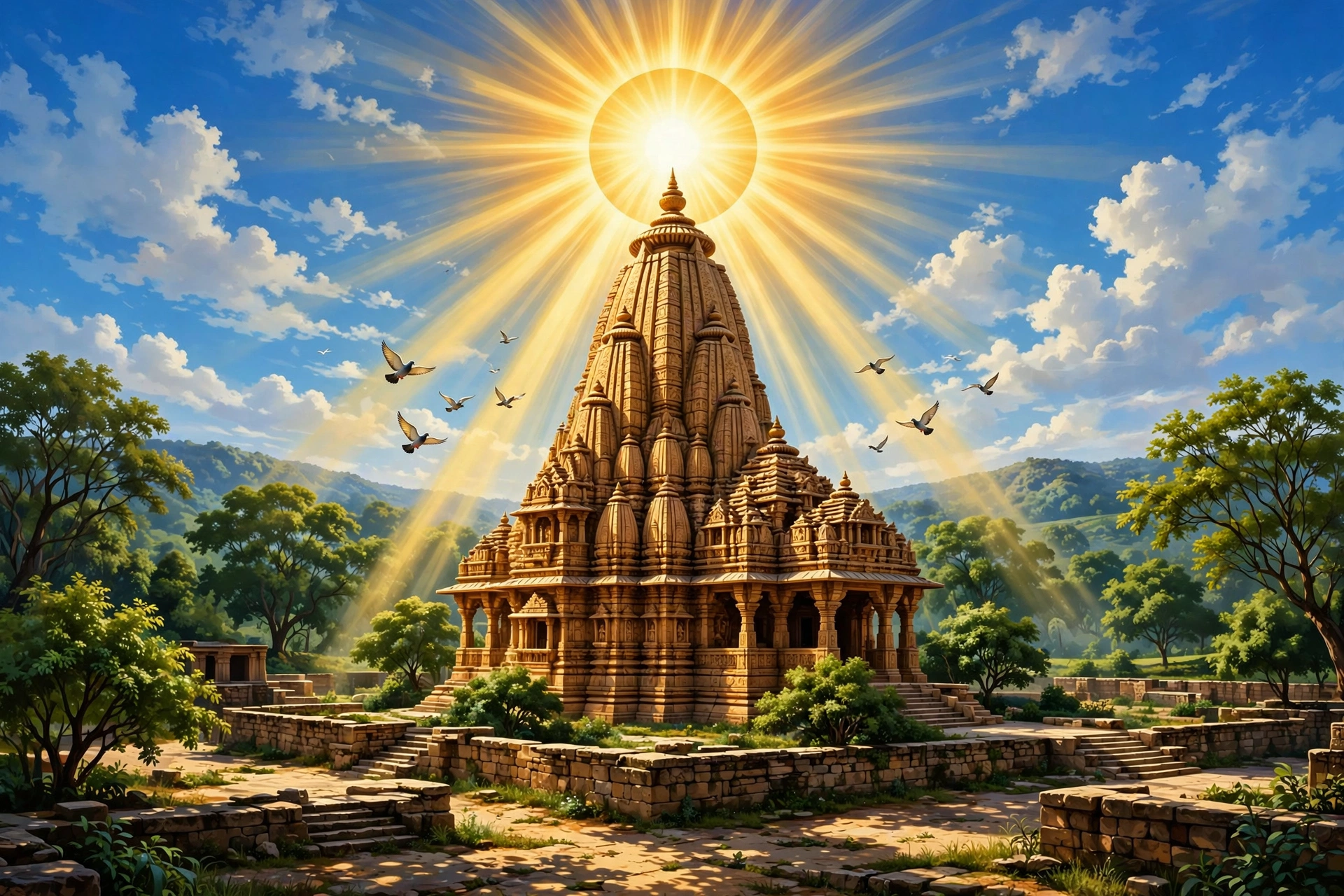
Ask a panditji for a good time to start something, and if he does not want to open the full panchang, there is a good chance he will say one word: Abhijit. It is the midday window ordinary families use for opening a shop, signing papers, or beginning a journey, and it comes around every single day. No special date, no waiting for a festival. Just the sun, at its highest, doing the work.
That simplicity is why it is worth understanding properly: powerful in tradition, but not a magic stamp. Here is what it is, how to find it, and where tradition draws the line.
What Exactly Is Abhijit Muhurat?
The name Abhijit means victorious, or unconquered. In Vedic timekeeping, the stretch from sunrise to sunset is divided into 15 equal parts, each one muhurta. Abhijit is the 8th of those 15, the one sitting right in the middle of the day, straddling local solar noon.
On a 12-hour day, each muhurta lasts 48 minutes, so Abhijit runs for about 48 minutes around noon. Tradition calls it capable of destroying innumerable doshas, which is why it became the default window when no special muhurta had been worked out. The story most often quoted is that Lord Shiva destroyed Tripurasura during Abhijit, and that Lord Vishnu’s Sudarshan Chakra clears doshas in this window. Another much-loved telling says Krishna chose Abhijit for the Pandava side at the start of the Kurukshetra war. Tradition also notes that at midday the Sun stands in the 10th house from the Lagna, the house of karma, at its highest point.
How to Find It for Your City in Three Steps
Abhijit is not fixed at 12 o’clock on your watch. It moves with your city’s sunrise and sunset, so it shifts a little every day and differs from city to city:
- Step 1: Look up your city’s sunrise and sunset for the day on our today’s panchang page.
- Step 2: Find the midpoint between them. That is your local solar noon, often a few minutes off 12:00 clock time.
- Step 3: Abhijit is the 8th of the 15 equal daytime parts, roughly 24 minutes before solar noon to 24 minutes after it.
Take the textbook example. If the sun rises at 6:00 AM and sets at 6:00 PM, the day is 12 hours long, each muhurta is 48 minutes, and Abhijit runs from 11:36 AM to 12:24 PM. On a longer or shorter day the window stretches or shrinks with it: by the same 15-part maths, a 10-hour winter day gives a 40-minute Abhijit, and a 14-hour summer day gives about 56 minutes. Panchangs may differ by a few minutes, so check the day’s panchang rather than memorising one clock time. Also check the day’s other windows, since Rahu Kaal and the daily Choghadiya segments run on their own cycles.
The Other Abhijit: The 28th Nakshatra
This is where people get confused, so let us separate the two Abhijits. Apart from the daily muhurta, there is also an Abhijit nakshatra, a short extra star-segment counted in older lists as the 28th nakshatra. It spans from 6 degrees 40 minutes to 10 degrees 53 minutes 20 seconds in Makara (Capricorn), tucked between Uttara Ashadha and Shravana, and it is linked to the bright star Vega, to Brahma as presiding deity, and to a triangle as its symbol.
Here is the honest distinction: the standard working zodiac uses 27 equal nakshatras of 13 degrees 20 minutes each, and Abhijit is not part of that system for birth charts, dasha calculations, or matching. It survives as a muhurta nakshatra, a time-selection idea, not as your birth star.
Where It Genuinely Helps, and Where It Does Not
Tradition recommends Abhijit for everyday beginnings: starting a new business, opening a shop, signing an agreement, beginning a journey, starting studies, or taking an important decision when you cannot get a full muhurta worked out. That is its real job, a reliable fallback when the perfect window is not available.
But tradition also draws three clear lines:
- Not on Wednesdays. Classical texts say plainly that Abhijit should be set aside on Wednesday. On other days it holds; on Wednesday it is treated as weakened, so use a good Choghadiya period or Hora instead.
- Not for weddings or Upanayana. Marriage and the sacred-thread ceremony are major Manglik rites with their own detailed muhurta rules, and Abhijit is not a substitute for them.
- Not for travelling south. In traditional travel astrology, starting a journey towards the south during Abhijit is avoided, since the south belongs to Yama and the midday sun stands in that direction.
Put together, the picture is refreshingly sane. Abhijit does not override a bad panchang in the sense of cancelling every rule. What tradition actually says is narrower and more useful: it cancels many minor doshas, so for ordinary beginnings it is a strong, safe default. For the big life ceremonies, do the full homework, with a proper muhurta from our Muhurta Helper or a trusted pandit. Festival timings still need their own care: Karwa Chauth 2026 has its own evening puja muhurat and moonrise, and the Diwali Lakshmi Puja muhurat is fixed by tithi and Pradosh Kaal, not by the midday window.
Used like that, with its limits respected, Abhijit earns its name: not because it magically fixes a bad day, but because it gives every ordinary day one clean, bright, well-lit moment to begin.
FAQs
Is Abhijit Muhurat the same time every day? No. It follows your city’s sunrise and sunset, so it shifts daily and varies by city.
Can I get married during Abhijit Muhurat? Tradition says no. Weddings and Upanayana need their own detailed muhurta.
Is Abhijit nakshatra my birth star? Not in the standard system. The usual chart uses 27 nakshatras; Abhijit is an extra muhurta segment, not a birth-star placement.