 Shrimad Astro

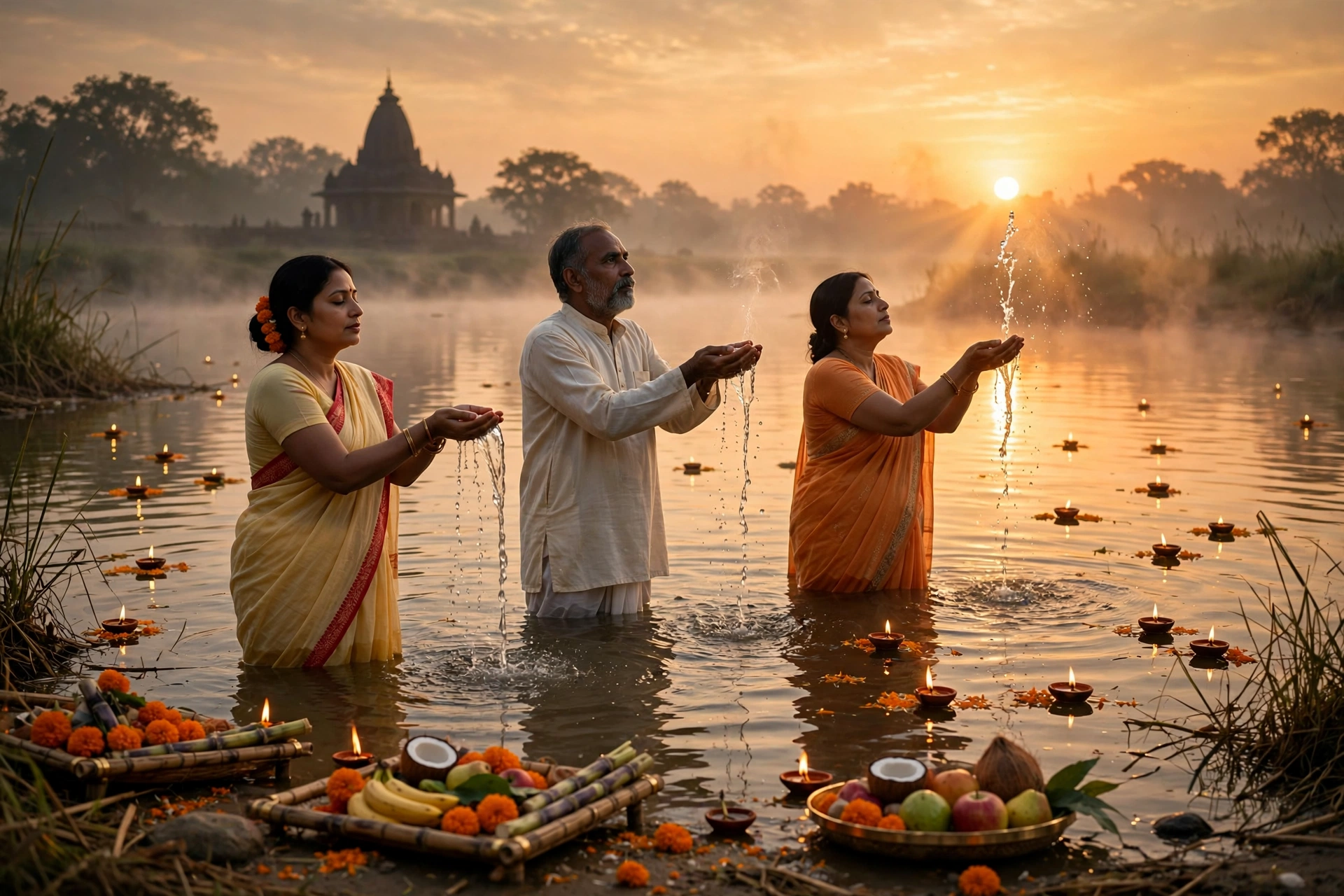
Most Hindu festivals hand you a murti to worship and a temple to visit. Chhath doesn’t bother with either. At dawn and dusk, thousands of people walk into rivers — waist-deep, holding bamboo trays of fruit and wheat cakes — and pray to the one god nobody can deny seeing: the sun itself. Here’s the whole festival, day by day.
First, why only the Sun?
Chhath (from the Sanskrit word for “six”) falls on Shashthi, the sixth day of the Kartik Shukla Paksha — in 2026 that’s Sunday, 15 November. The festival honours two powers at once: Surya, the sun who feeds every crop and every life on earth, and Chhathi Maiya, the gentle goddess of the sixth day, who watches over children and family welfare.
Here’s what’s unusual: no idols, no temple queues. Devotees offer water directly to the sun at the two moments it looks weakest — sinking at dusk, rising at dawn. Worshipping the sun while it’s going down is Chhath’s quiet signature: gratitude for what the year gave, and faith that the light returns. The sun is called the Pratyaksh Dev, the visible god — and it’s why this ritual has stayed almost unchanged for centuries.
The heartland is Bihar, Jharkhand, eastern UP and Nepal, though Bihari communities now celebrate wherever they live, from the Yamuna ghats in Delhi to riverside parks abroad.
Day 1 — Nahay Khay, Friday 13 November
Day one is purification. The vrati (the fasting devotee, usually the woman of the house) takes a ritual bath, the whole house is cleaned top to bottom, and the kitchen goes strictly sattvic for four days.
The day’s one meal is humble: kaddu (bottle gourd) ki sabzi, chana dal, and rice. Anyone who’s tasted nahay-khay khana will tell you there’s something about the discipline that makes plain rice taste like a feast.
Day 2 — Kharna, Saturday 14 November
Kharna is the discipline day. The vrati fasts from sunrise to sunset — traditionally without water — and spends the evening cooking the Kharna prasad: gur ki kheer (jaggery rice pudding) over an earthen chulha, plus fresh rotis and banana.
After sunset, the kheer is offered to the sun and Chhathi Maiya, then shared as prasad with family and neighbours. The moment the vrati eats, the 36-hour nirjala fast (no food, no water) begins — the hard part of Chhath.
Day 3 — Sandhya Arghya, Sunday 15 November (the main day)
This is the Chhath you’ve seen in photographs. Late afternoon, the whole family gathers at the river, pond or ghat in fresh clothes, carrying soop (bamboo trays) loaded with thekua, coconut, sugarcane, bananas, and earthen diyas.
The vrati walks into the water as the sun dips. Standing waist-deep with thousands of others, she pours water from cupped hands toward the sinking sun — the Sandhya Arghya, the evening offering. Diyas float, Chhath songs rise, and the riverbank turns gold.
One practical note: sunset times differ by city, so check the day’s panchang for your exact timing and reach the ghat early — the good spots fill fast.
Day 4 — Usha Arghya, Monday 16 November
Before sunrise, the families are back at the water. The vrati hasn’t eaten or drunk anything for a day and a half, and there’s a particular hush on the morning ghat — tired, watchful, expectant. As the first edge of the sun clears the horizon, the Usha Arghya is offered to the rising sun: prayers for health, children, and the family’s prosperity.
Then, finally, the fast breaks. Prasad is distributed to everyone present — the thekua, the fruits, the kheer from two nights ago — and the four days end the way Indian festivals always end: by feeding people.
Worth knowing before you go
The prasad everyone talks about is thekua — a wheat-flour-and-jaggery cookie that somehow tastes better at Chhath than on any other day. Devotees carry basketloads home to distribute; refusing a thekua at Chhath is genuinely hard.
Chhath happens twice a year. The big Kartik Chhath is the November one, but there’s a smaller Chaiti Chhath in the Chaitra month (spring), same four-day pattern.
If the theme of gratitude to the sun struck you, the Sanatan Shastra library carries the Navagraha stotra collection with hymns dedicated to Surya — worth reading after you’ve watched an arghya at dawn. And since Chhath arrives just after the Diwali week, revisit the season’s start with our Diwali 5-day calendar or the Diwali Lakshmi Puja vidhi.
Quick answers
Is Chhath only for women? No — women observe it most often as the vrati, but anyone of any age can keep the fast, and many men do.
Is Chhath celebrated outside Bihar? Yes — wherever Bihari and eastern-UP communities live. Delhi, Mumbai, Kolkata all have major ghat celebrations now.
What are the exact 2026 dates? Friday 13 November (Nahay Khay), Saturday 14 November (Kharna), Sunday 15 November (Sandhya Arghya, main day), Monday 16 November (Usha Arghya and parana).