 Shrimad Astro

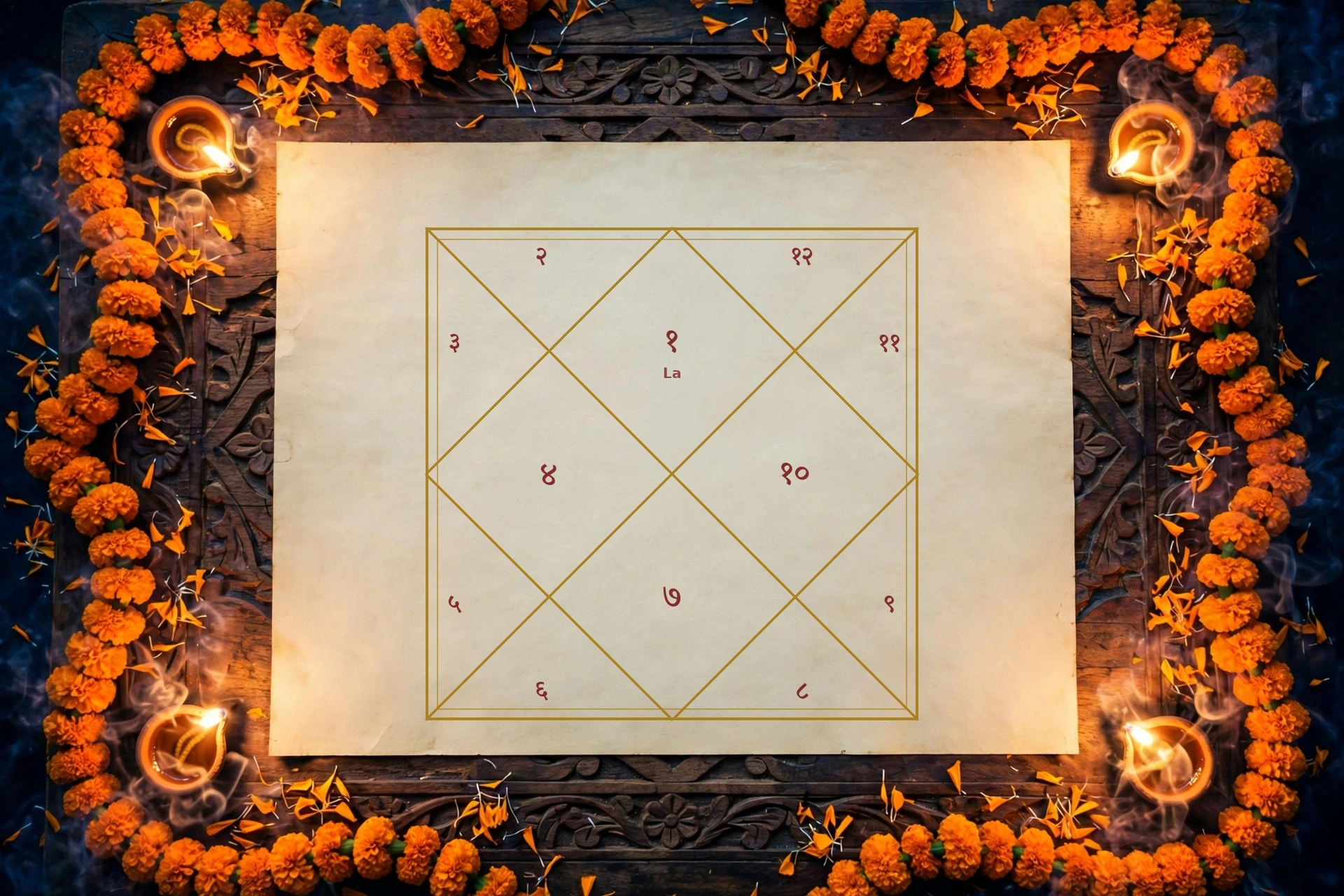
Every Indian family has this scene. Someone’s marriage gets fixed, a pandit opens his laptop, and out comes a diamond-shaped chart full of boxes and numbers. Everyone nods wisely. Nobody understands a thing. That chart is your kundli — and it isn’t as mysterious as it looks. It has exactly 12 rooms, called bhavas or houses, and each room runs one department of your life. Learn the rooms, and you can follow any pandit, anywhere.
First, Spot the Diamond at the Top
In a North Indian kundli the rooms never move. The diamond at the very top is always house 1 — your Lagna, the sign rising on the eastern horizon the moment you were born. The little numbers in the boxes aren’t house numbers; they’re the zodiac signs, 1 for Aries through 12 for Pisces, always running counterclockwise from your Lagna. That’s why two people with the same Moon sign can live completely different lives. Generate your free janam kundli and look at the number in the top diamond — that’s you. If you’re unsure which sign was rising, the rising-sign calculator will find it.
Houses 1 to 6: You, Your Money and the Daily Grind
- 1st house (Lagna): body, looks, personality, health, confidence — the most important room.
- 2nd house: wealth, family, savings and speech — how money and words flow through your life.
- 3rd house: courage, younger siblings and your own hustle — this room rewards effort.
- 4th house: mother, home, property, vehicles and inner peace — your private world.
- 5th house: children, intelligence, education, romance and past-life merit.
- 6th house: enemies, debts, disease and competition — the room that tests you; also service and daily work.
Houses 7 to 12: The World Outside
- 7th house: spouse, marriage and partnerships — every serious one-to-one relationship, including business partners.
- 8th house: longevity, sudden twists, secrets, research and the occult — the room nobody discusses at family dinners.
- 9th house: fortune, father, gurus, higher learning and long journeys — the luckiest room.
- 10th house: career, status and reputation — the room the whole world sees.
- 11th house: gains, income, friends and elder siblings — the room of wishes that come true.
- 12th house: expenses, foreign lands and sleep — and moksha. What you spend, and what you surrender.
Kendra, Trikona and the Houses Nobody Wants
Pandits don’t treat all twelve rooms equally. The kendras (1, 4, 7, 10) are the four pillars — self, home, partner, career — and planets here act with unusual strength. The trikonas (1, 5, 9) are the dharma houses of self, brains and luck. House 1 sits in both groups, which is why your Lagna outranks everything else.
Then come the dusthanas (6, 8, 12) — the houses of struggle. An honest opinion: don’t panic if a planet sits in one. These rooms build grit, and the texts themselves say the upachaya houses (3, 6, 10, 11) are “growth houses” where malefics famously improve with age — Saturn in the 6th can make you unbeatable in competition by your forties. The 2nd and 7th are called maraka houses and are read carefully only in longevity questions; not a daily worry.
How a Pandit Actually Reads a House
Three layers, that’s the whole game. The house says where — career, marriage, money. The planet says who — Jupiter expands the room, Saturn tests it. The sign says how — fiery Aries acts differently from steady Taurus. Read the 12 rashi traits once and this layer clicks.
One more secret: check the house’s lord — the planet ruling the sign in that room — and where that lord has gone. An empty house with a strong lord beats a crowded house with a weak one. Planets also cast glances: every planet aspects the house opposite it, while Jupiter also aspects the 5th and 9th from itself, Mars the 4th and 8th, Saturn the 3rd and 10th.
That’s enough to read any chart with confidence. From here, find your Moon’s birth star in the 27 nakshatras guide, watch what’s moving through your rooms in the planetary transit guide, and when a room looks weak, the stotra collections in the Sanatan Shastra library are where the classical remedies live.
FAQs
Is my Lagna the same as my rashi? No. Your rashi — your Moon sign — is where the Moon sat at birth. Your Lagna is the sign rising on the eastern horizon. Two different things, and pandits care about both.
Do I need my exact birth time? For the Lagna, yes — it changes roughly every two hours. A few minutes off rarely matters, but an hour off can flip the whole chart.
One house is empty and another has four planets — is that bad? Completely normal. Empty rooms aren’t broken — check the house lord. Four planets in one room just means that department of life keeps you busy.