 Shrimad Astro

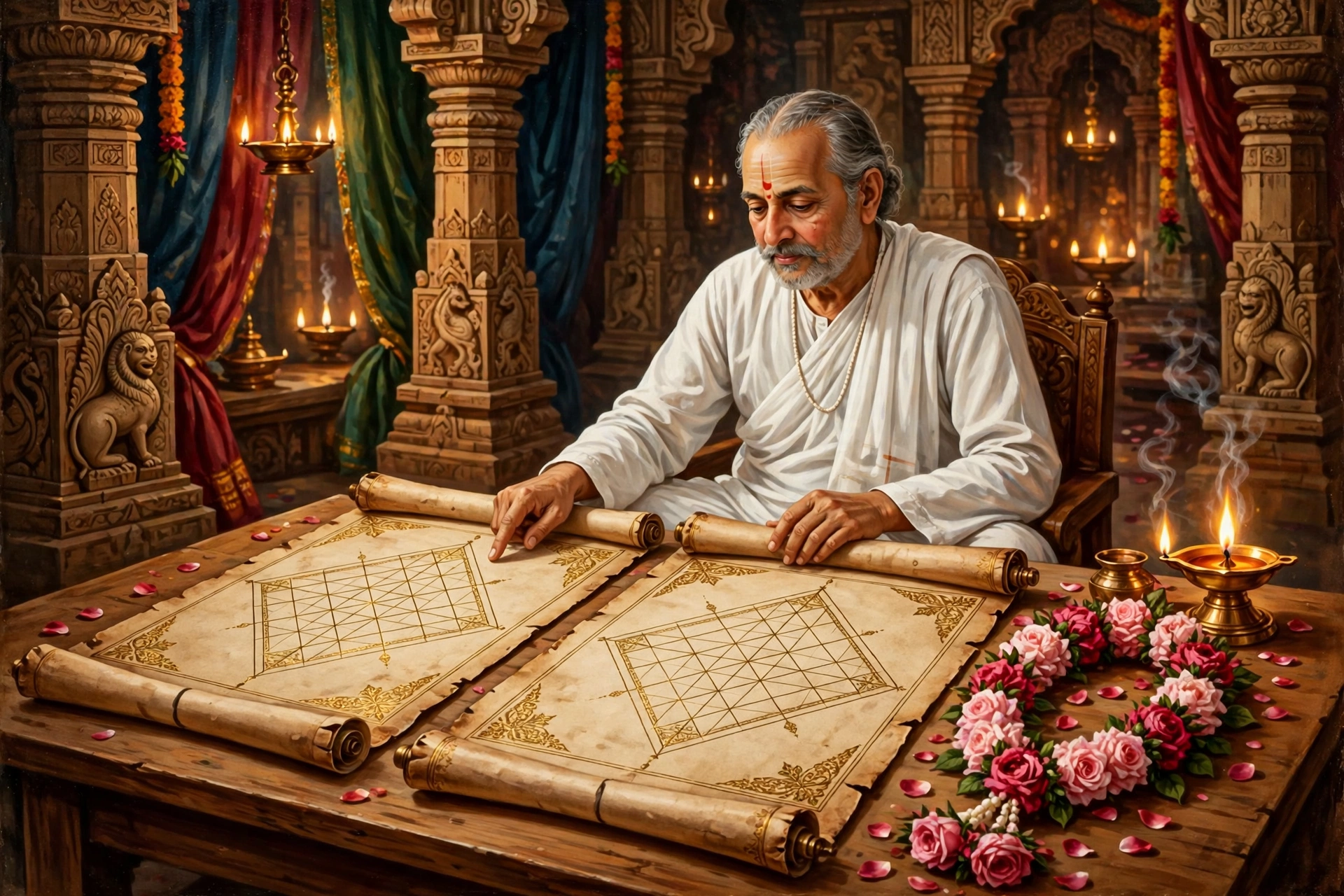
In most Indian homes, matchmaking follows a fixed script. Biodata exchanged, families like each other — and then someone, usually an uncle with a knowing look, asks the only question that matters: “Guna kitne mile?” A number out of 36 can stall a proposal before the couple has even met. But almost nobody outside a pandit’s study knows what those 36 points measure.
The system is called Ashtakoota Milan: eight compatibility tests (“kootas”) adding up to 36 points. Every test reads only two things — the Moon’s sign and the Moon’s nakshatra in each chart. That is why Vedic matching is obsessed with the Moon: it shapes emotional wiring. You can run the free 36-guna Kundli Matching calculation on our site; here is what each koota is really checking.
Where the 36 comes from
The kootas are weighted very unequally: Varna 1, Vashya 2, Tara 3, Yoni 4, Graha Maitri 5, Gana 6, Bhakoot 7, Nadi 8. The points rise as the koota gets more personal — a zero in a 1-point koota barely dents the total, while a zero in an 8-point koota can sink the match. The quoted passing line is 18 out of 36, with 24+ considered strong. What matching sites rarely say: the 18-point line is a convention, not a verse from any classical text. Pandits routinely proceed below it — the score is a screening tool, not a verdict.
The lightweights: Varna, Vashya, Tara, Yoni
Varna (1 point) sorts each Moon sign into a temperament bucket: water signs (Cancer, Scorpio, Pisces) are Brahmin, fire signs (Aries, Leo, Sagittarius) Kshatriya, earth signs (Taurus, Virgo, Capricorn) Vaishya, air signs (Gemini, Libra, Aquarius) Shudra. The point is awarded when the groom’s varna equals or outranks the bride’s. Read these as temperament categories, not a social ranking.
Vashya (2 points) asks who influences whom. Signs fall into five creature-classes — human, quadruped, water-creature, wild animal, insect — and a traditional table scores the pairing. Same-group pairs usually take the full 2; predator-and-prey style combinations drop to 0. It reads the relationship’s power dynamics, not character.
Tara (3 points) counts the distance between the two birth nakshatras and sorts it into nine taras. Sampat, Kshema, Sadhaka, Mitra and Parama Mitra support health and wellbeing in married life; Vipat, Pratyari and Vadha are the difficult ones. Our birth nakshatra calculator finds yours in seconds.
Yoni (4 points) maps each nakshatra to one of 14 animal symbols — horse, elephant, serpent, dog, cat, rat, cow, tiger, lion and five more. Same animal scores 4, friendly pairs (horse-elephant, elephant-cow) score 3, most neutral pairs 2, and natural enemies — cat and rat, serpent and mongoose, cow and tiger — score 0. It reads the instinctive layer of daily life: how two people rest, argue and make up.
The middleweights: Graha Maitri and Gana
Graha Maitri (5 points), “friendship of planets”, compares the lords of the two Moon signs. Natural friends (Jupiter and Mars) take the full 5, neutrals take 3, enemies (Venus and the Sun) take 0.
Gana (6 points) sorts nakshatras into three temperaments: Deva (divine — Ashwini, Pushya, Revati and six more), Manushya (human — Bharani, Rohini, Ardra and six more), Rakshasa (fierce — Krittika, Magha, Jyeshtha and six more). Same gana takes 6, a Deva-Manushya mix 5, Manushya-Rakshasa just 1, Deva-Rakshasa 0 (Gana dosha). These describe temperament, not morality.
The heavyweights: Bhakoot and Nadi
Bhakoot (7 points) measures the distance between the two Moon signs. Three axes score a flat zero — the 2nd-12th, 5th-9th and 6th-8th — called Bhakoot dosha; everything else scores the full 7.
Nadi (8 points) is the heavyweight champion. The 27 nakshatras divide into three nadis — Aadi, Madhya, Antya. Different nadi: full 8. Same nadi: 0 — Nadi dosha, the most serious flag in matching. The texts do list cancellation conditions (the best-known: both partners sharing the same nakshatra pada), so a zero here is a question for a knowledgeable pandit, not an automatic rejection.
What the score actually tells you
My honest opinion: the 36-guna score is an excellent first filter and a terrible final judge. It ignores most of both charts — the ascendant, the Navamsha (D9) chart that speaks specifically about marriage, the dashas running at wedding time, and the separate Mangal dosha check (Mars in houses 1, 4, 7, 8 or 12 from the ascendant) that runs alongside the gunas. Two people can score 30 and still need work; two can score 16 and do beautifully.
Use the number as designed: the beginning of the conversation, not the end. Get both free janam kundalis made, check the Navamsha for marriage strength, then pick the day from auspicious marriage dates — a good match still deserves a good muhurat.
Quick answers
Is 18 out of 36 compulsory? No — a convention, not a scriptural rule. Where points were lost matters more than the total.
We have Nadi dosha. Is the match over? Not automatically — the tradition recognises cancellations a competent astrologer should check first.
We scored 32. Is a happy marriage guaranteed? No. The gunas skip the ascendant, Navamsha and dashas — and real life. Communication and shared values outweigh all 36 points.