 Shrimad Astro

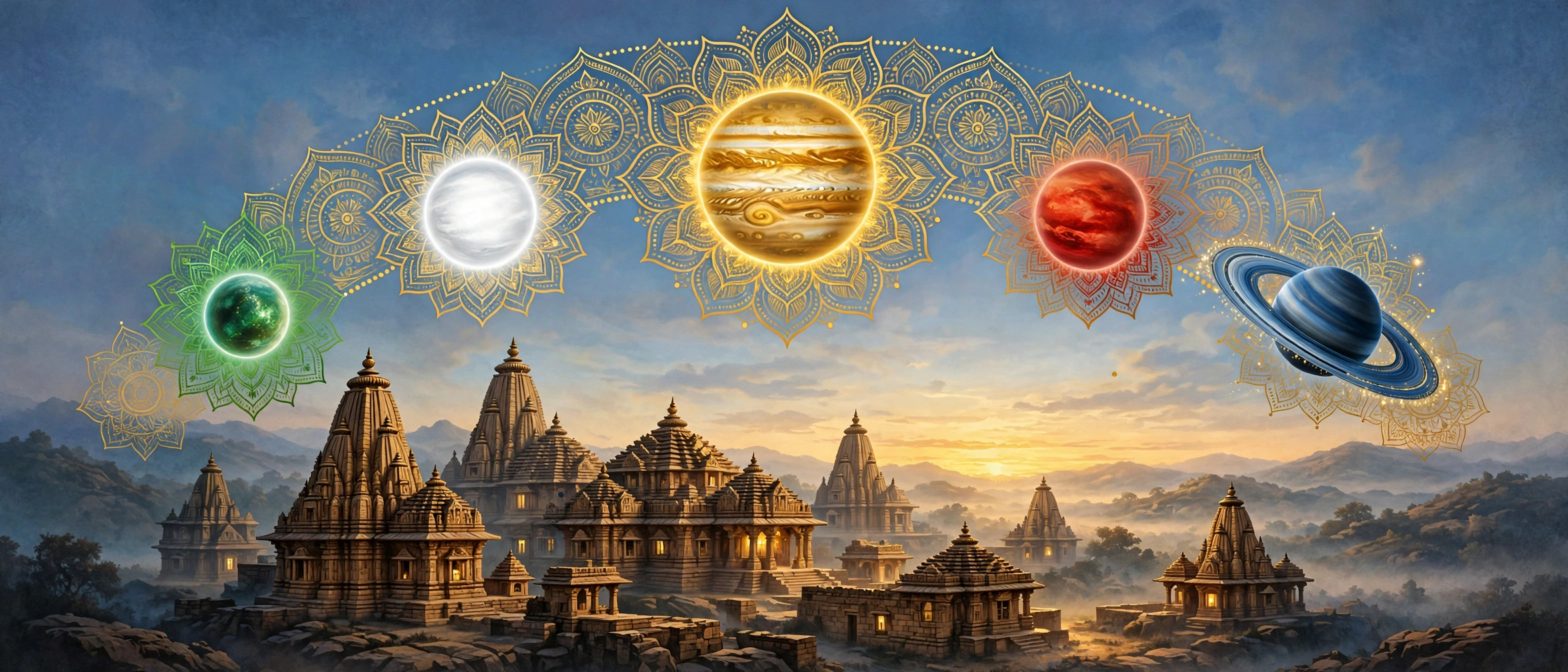
Ask any astrologer which combinations they look for first in a new chart, and sooner or later you will hear the words Panch Mahapurusha Yoga. It sounds grand — “the yoga of five great men” — and it is treated as one of the most respected combinations in Vedic astrology. But what does it actually mean? The honest answer is more interesting than the hype.
What “Mahapurusha” Actually Means
Pancha means five, and Mahapurusha means a great person. The rule, given in classical texts like the Brihat Parashara Hora Shastra and the Phaladeepika, is simple: one of the five true planets — Mars, Mercury, Jupiter, Venus or Saturn — must sit in a kendra house (the 1st, 4th, 7th or 10th from the ascendant) in its own sign or its exaltation sign. Five independent sources agree on this formation rule.
The Sun and the Moon never form this yoga, and neither do Rahu and Ketu — only the five planets from Mars to Saturn qualify. The kendra houses are the pillars of the chart: the 1st is the self, the 4th is home, the 7th is partnership, the 10th is career. Some modern writers also count the trikona houses (1st, 5th, 9th), but the classical rule is kendra only, and that is the version this article follows.
The Five Yogas, One by One
Ruchaka Yoga — Mars in Aries, Scorpio or Capricorn in a kendra: courage, strength and decisiveness. The Phaladeepika says such a person gains wealth through courageous deeds — the soldier, the athlete, the protector.
Bhadra Yoga — Mercury in Gemini or Virgo in a kendra: a sharp mind, clear speech and business sense. Tradition describes an eloquent person — the writer, the trader, the counsellor. Mercury is exalted in Virgo, so Bhadra in the 1st or 10th house is considered especially strong.
Hamsa Yoga — Jupiter in Sagittarius, Pisces or Cancer in a kendra: wisdom, dharma and teaching. Hamsa means swan, the bird of discernment — tradition describes a righteous, respected person people turn to for advice.
Malavya Yoga — Venus in Taurus, Libra or Pisces in a kendra: grace, beauty, artistic talent, comfort and a happy married life. Venus is exalted in Pisces, so Malavya with Venus in Pisces in a kendra is the classic textbook example.
Sasa Yoga — Saturn in Capricorn, Aquarius or Libra in a kendra. The odd one out, and my favourite: Saturn gives nothing quickly. Sasa traditionally describes a person who begins modestly and rises through discipline and staying power — the administrator, the judge, the leader who commands authority through competence.
Why Most Charts Don’t Have One — And Why That’s Fine
A genuine Panch Mahapurusha Yoga is rare. The planet must be in the right house AND the right sign, and the old texts add conditions that make it rarer still: it should be free from combustion (too close to the Sun) and severe affliction, the ascendant should be strong, and the planet’s strength in the Navamsa (D9) chart matters too. You can check the strength side with our Ashtakavarga point system.
Even when the yoga is present, it does not switch on like a light. Classical teaching says a yoga fructifies mainly during the dasha of the planet that forms it. And a yoga is a potential, not a promise: the same Ruchaka Yoga can make a brave soldier or a reckless hothead. If your chart has none of the five, it means nothing bad at all — most charts don’t. A chart is judged as a whole; one combination never decides a life. Our Vipareeta Raja Yoga article makes the same point from the opposite direction.
How to Check Your Own Chart
Checking takes two minutes. Generate your free Janam Kundali with your exact birth date, time and place, and look at where Mars, Mercury, Jupiter, Venus and Saturn sit. Is any of them in the 1st, 4th, 7th or 10th house from your ascendant, in its own or exalted sign? If yes, you have a Panch Mahapurusha Yoga. Then check the same planet in your Navamsha (D9) chart — if it is strong there too, the yoga is traditionally considered much more reliable.
And if you find one, enjoy it — but read it the way the texts intend: a Mahapurusha Yoga describes a capacity — courage, clarity, wisdom, grace or endurance. The mantras of the planet that forms your yoga are traditionally recited to strengthen it, and the Navagraha Suktam in our Sanatan Shastra library is the classical text for honouring all nine grahas together.
Frequently Asked Questions
Can a chart have more than one Panch Mahapurusha Yoga? Yes. Two or even three are possible, though rare, and each is read separately — a person can have both Bhadra’s intellect and Sasa’s discipline.
Does having one guarantee success? No. The classical texts describe tendencies and potentials, not guarantees. Affliction, combustion, a weak ascendant and the dasha sequence all shape how much of the yoga actually shows in life.