 Shrimad Astro

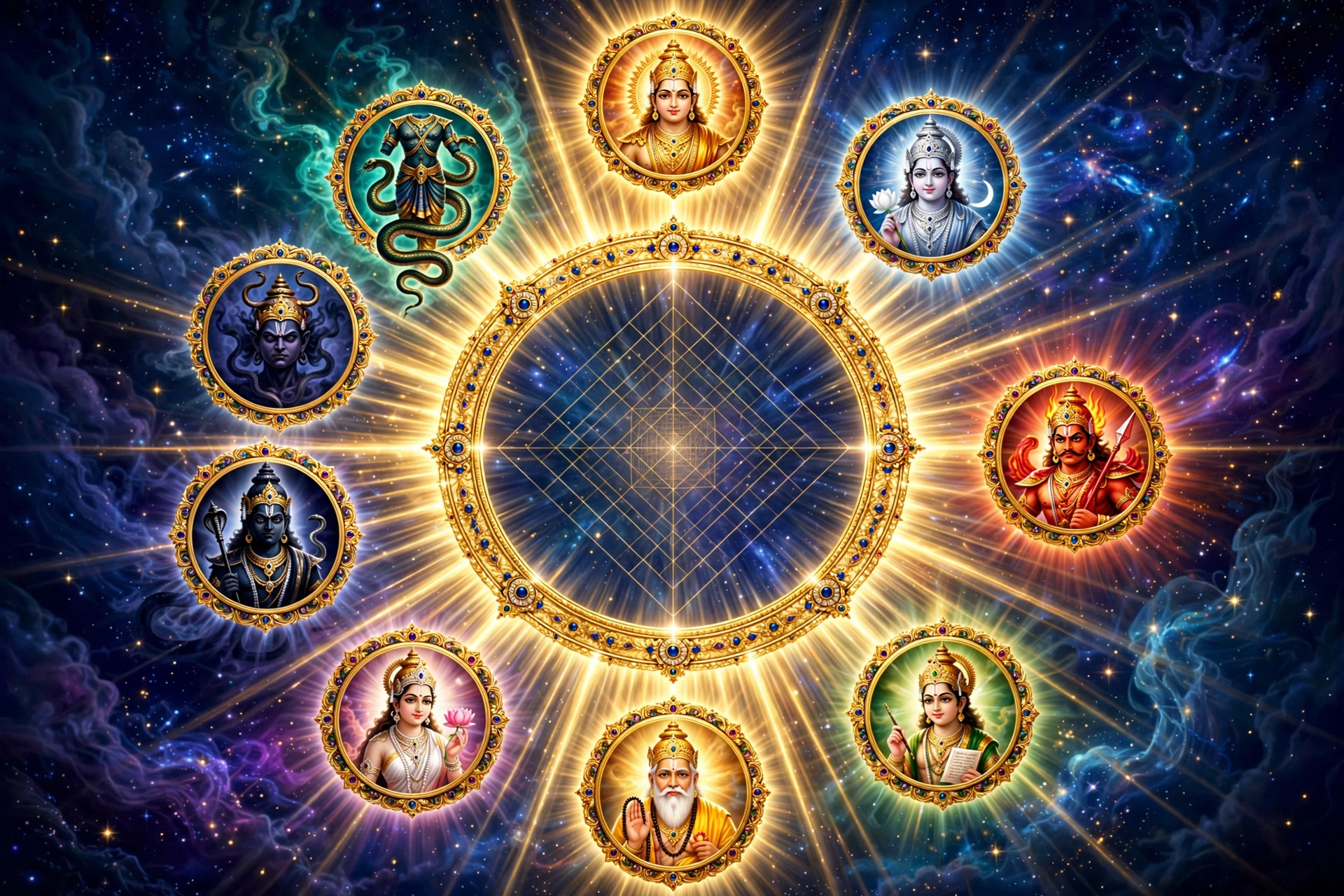
Have you ever wondered why the same person can look unstoppable for a few years, and then seemingly out of nowhere hit a stretch where everything stalls? Dadi would say “uska samay kharab chal raha hai” — his time is running badly. Vedic astrology takes that folk wisdom seriously and gives it a name: dashas. Think of them as the seasons of your life. The planets don’t change, but which one is holding the microphone changes — and that changes everything.
What Exactly Is a Dasha?
A dasha is simply a planetary period. The most famous system, Vimshottari Dasha, divides human life into a 120-year cycle shared among the nine grahas — “Vimshottari” literally means “pertaining to 120.”
Here is the fixed sequence, with each planet’s share of the 120 years:
- Ketu — 7 years
- Venus — 20 years
- Sun — 6 years
- Moon — 10 years
- Mars — 7 years
- Rahu — 18 years
- Jupiter — 16 years
- Saturn — 19 years
- Mercury — 17 years
That order never changes. What changes is where you enter the wheel.
How Your Starting Point Is Decided
This is the elegant part. Your entry point is set by the Moon’s position at birth — which of the 27 nakshatras it sat in. That is your Janma Nakshatra, and its ruling planet decides your first dasha. Moon in Rohini, Hasta, or Shravana? You began life in Moon Mahadasha. Moon in Ashwini, Magha, or Mula? Ketu’s seven years greeted you at birth.
And it is proportional. Each nakshatra spans 13 degrees 20 minutes of sky. If the Moon had already crossed half your birth nakshatra at your birth moment, you get only the remaining half of that planet’s dasha — the “balance of dasha.” The rest then run their full quota in the fixed order. This is why birth time matters: a few hours’ difference in the Moon’s position changes the calculation. Don’t know your birth nakshatra? Our birth nakshatra calculator finds it from your birth details, and all 27 birth stars are explained in our nakshatra guide.
The Layers Inside: Mahadasha, Antardasha and Beyond
The big period — the Mahadasha — is only the outer shell. Inside it run nine Antardashas (bhuktis), one per planet, in the same order, each lasting in proportion to its lord’s share of the 120 years. The division goes deeper still — Pratyantardasha, Sookshma, Prana. For important decisions, astrologers read three or four levels down. The outer planet sets the climate; the inner ones set the weather.
How to Read Your Own Dasha (the Practical Part)
Forget memorising tables. Here is how a sensible reading actually works:
- Find your current Mahadasha lord. Your free Janam Kundali prints the timeline — no manual maths needed.
- See where it sits and which houses it rules. Jupiter ruling the 10th house of career and placed in the 2nd of wealth tends to lift both; the same Jupiter badly placed tells a different story.
- Check the Antardasha inside it. A strong Mahadasha with a weak Antardasha gives mixed results. Judge the pair, never the Mahadasha alone.
- Confirm with transits. The old rule: dasha promises, transit delivers. Track the sky with our planetary transits guide.
Honest opinion: the most common mistake is reading a dasha in isolation. A “bad” planet — Saturn, Rahu, Ketu — well placed and ruling good houses can give a quietly excellent period; a “good” planet badly placed can disappoint. The planet’s name is the headline, not the story. The free 24-page Kundali PDF report prints the full Vimshottari sequence with dates.
What Dashas Don’t Tell You
A dasha tells you which energies are switched on — not that an event is guaranteed. Saturn’s 19 years don’t mean 19 years of suffering; they mean 19 years where Saturn’s themes — discipline, delays, slow-built rewards — run the show. Effort and remedies genuinely modulate a period: during a heavy stretch, planet-specific hymns like those in our Sanatan Shastra library exist precisely because periods can be navigated, not just endured.
Frequently Asked Questions
How do I find which dasha I am in right now?
Your free Janam Kundali lists the current Mahadasha, Antardasha, and their end dates automatically.
Can two people in the same dasha get totally different results?
Yes. Placement, house rulership, strength, and the running Antardasha differ for every chart. Same planet, different horoscope, different story.
Does a dasha override Sade Sati?
No — they layer. Sade Sati is a Saturn transit condition; dasha is your personal time-lord. Read them together.